The ANTIKYTHERA MECHANISM and the NATIONAL ARCHAEOLOGICAL MUSEUM – ATHENS.

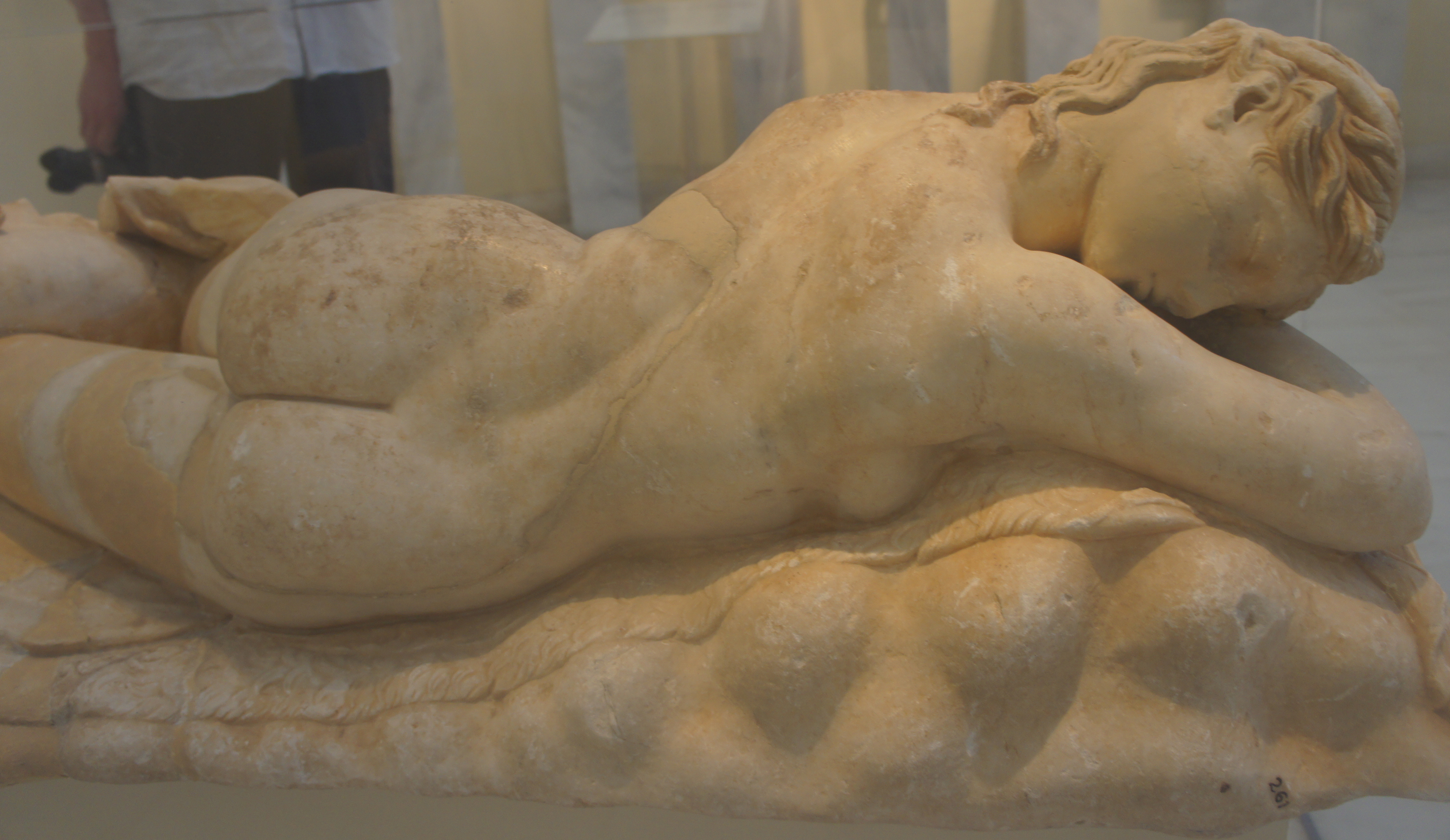
This is a statue of a sleeping Maenid found on the southern side of the Athenian Acropolis. Circa AD117-138. Photo by JE

The National Archaeological Museum in Athens was my favourite museum of all those we visited. It was serendipitous that we visited this museum and were able to see the Antikythera Exhibition.

This is a statue of a kouros made in Naxian marble and found in Souniaon at the Temple of Poseidon. Circa 600BC. Photo by JE

I hadn’t  known where this extraordinary exhibition was when scheduling our trip and it is one I’ve longed to see. It did not disappoint.

Notice the difference in the detail between the two kouros statues despite the mere seventy or so years between their creation.

This is a statue of a kouros in Parian marble. It was removed from the grave of Kroisis and liberated from France in 1934. Circa 530BC. Photo by JE

The inscription on the memorial to this young man reads as follows:

Stop and mourn at the grave of dead Kroisis whom the raging Ares destroyed when he fought among the defenders.”

This museum had been renovated for 2004, and it is fantastic. There is a chronological logic to the way the permanent exhibits are now displayed.
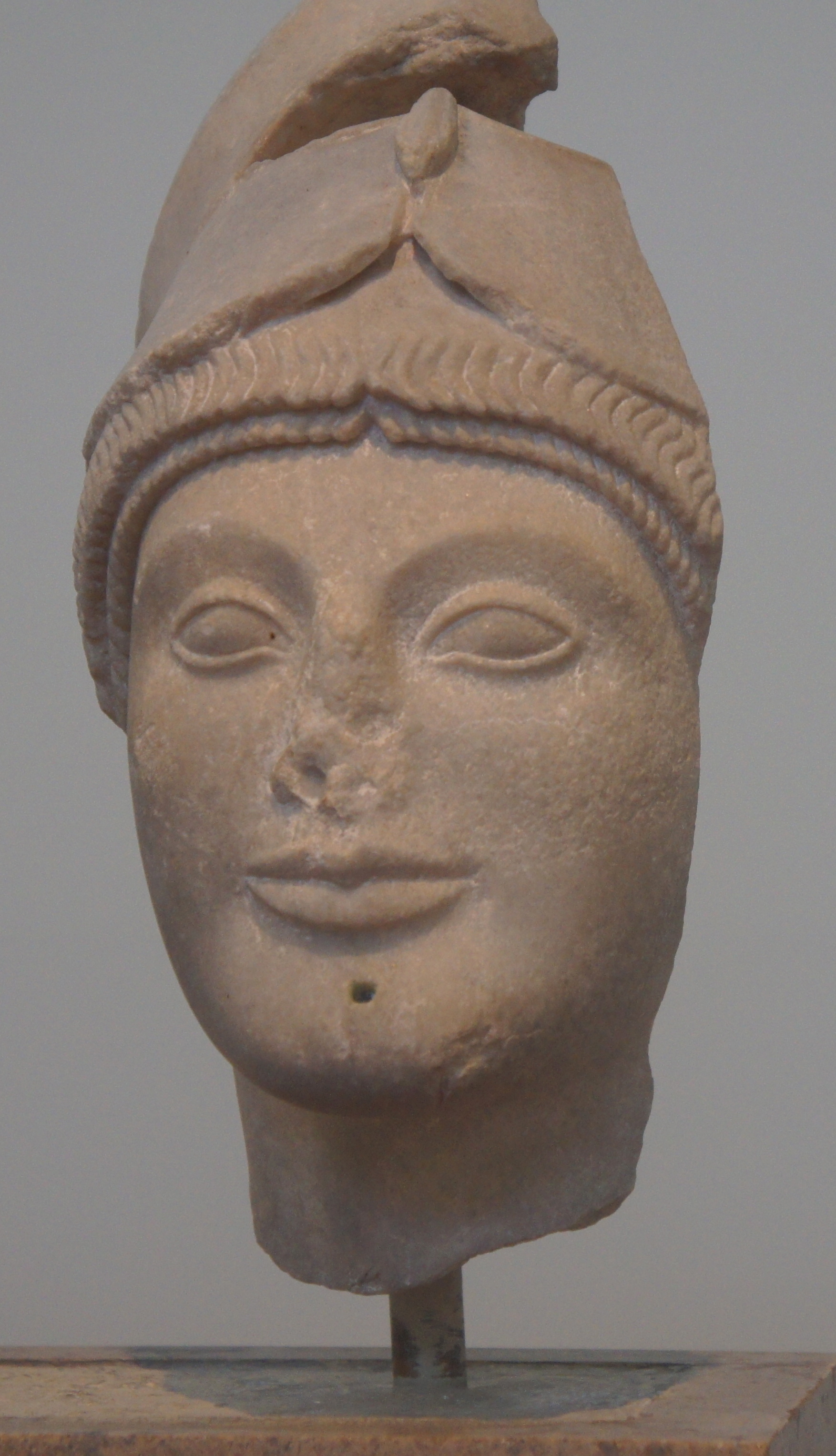
Head statue

Part of a sculpture from the Temple of Aphaia on Aegina Island. circa 500BC. Photo by JE

The written history to each item – where it was found, what its purpose was and its significance to the people at that time – is always informative and often insightful.
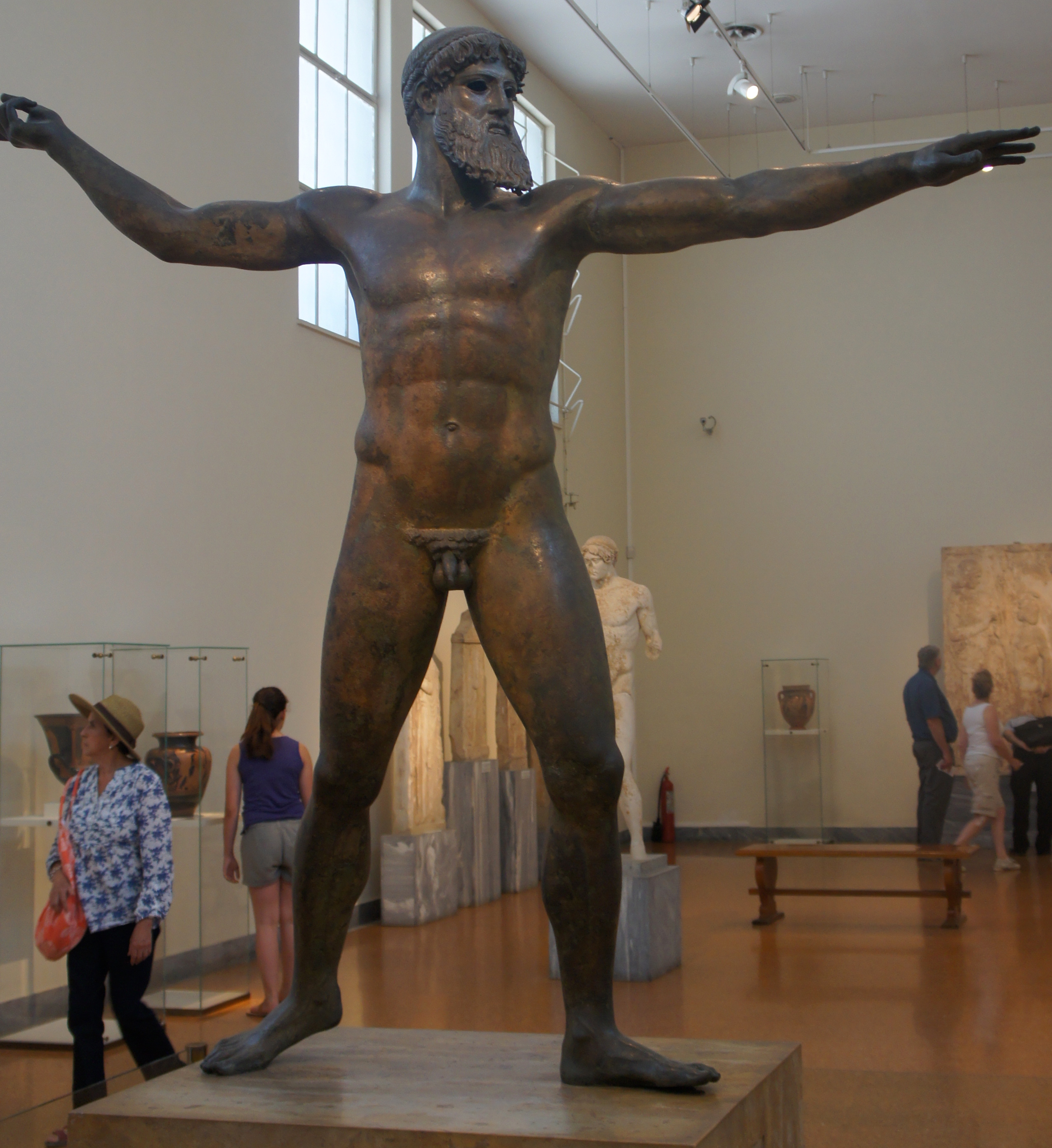
A bronze statue of Zeus or Poseidon found in the sea off Cape Artemision. circa 460BC. My money is on Zeus. Photo by JE

So many of the archaeological sites we visited had signs stating that the items discovered were now on display at this museum.
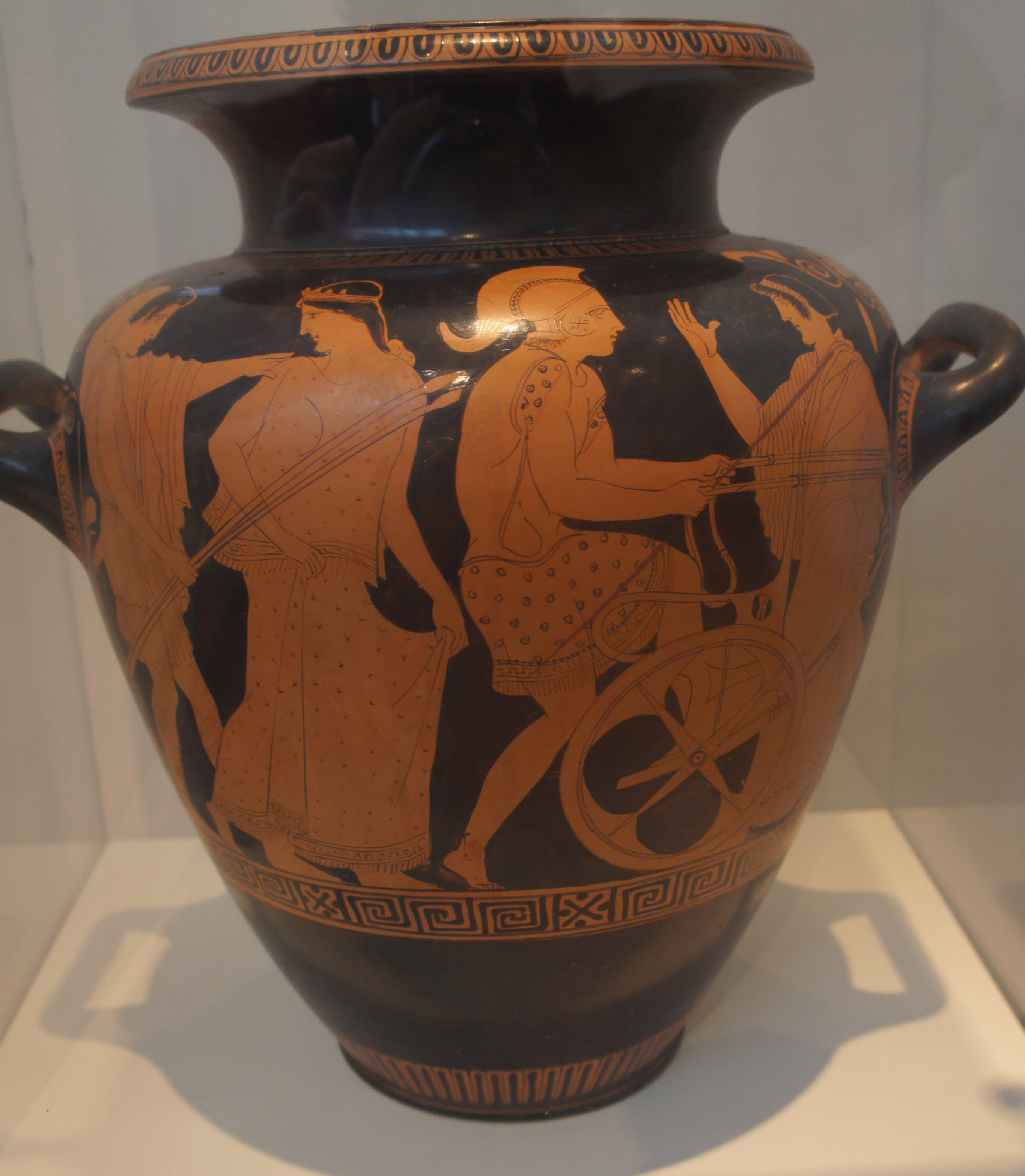
 

The figures depict the leads in the story of Troy. It was used as a funerary urn and painted by Polygnotos in circa 430-420BC Photo by JE

3D comes to Ancient Greece with this funerary relief / statue found near Piraeus. He was Alexos, son of Stratokles of Sounion. Circa 320BC. Photo by JE


We were able to catch up with artefacts from the Temples of Aphaid and Apollo, Aegina Island, the ancient city of Corinth, the Temples of Poseidon and Zeus, archaeological digs on Santorini and Rhodes, sites whose stories were now so familiar to us.

The statue of Poseidon was found on Milos. He is missing his trident but has his trusty helper, the dolphin, next to his right leg. Circa 125-100BC Photo by JE

I hope the many photographs give you the feeling of wandering through galleries filled with the wonders of Greece.

This bronze head of a boxer was found at Olympia. He was a champion and they, the museum powers that be, believe that it belonged to Satyros of Elis, who was the Muhammad Ali of his day. The sculptor was Silanion. Circa 330-320BC. Photo by an impressed JE.

Portrait of a head with speculation as to the identity of the man it portrays. Some say an unnamed poet, others believe it is Attalos II from Pergamon who ruled from 159-139BC. Does he have the face of a poet or a ruler? This was my favourite piece among the main body of the museum as I spent hours trying to decide. His face is so ‘modern’, if that makes any sense. The jury is still out. Photo by JE.

Bronze of the Emperor Augustus (29BC-AD14). This bronze was found in the Aegean Sea between the islands of Euboea and Agios. It is thought to have been cast between 12-10BC. Photo by JE
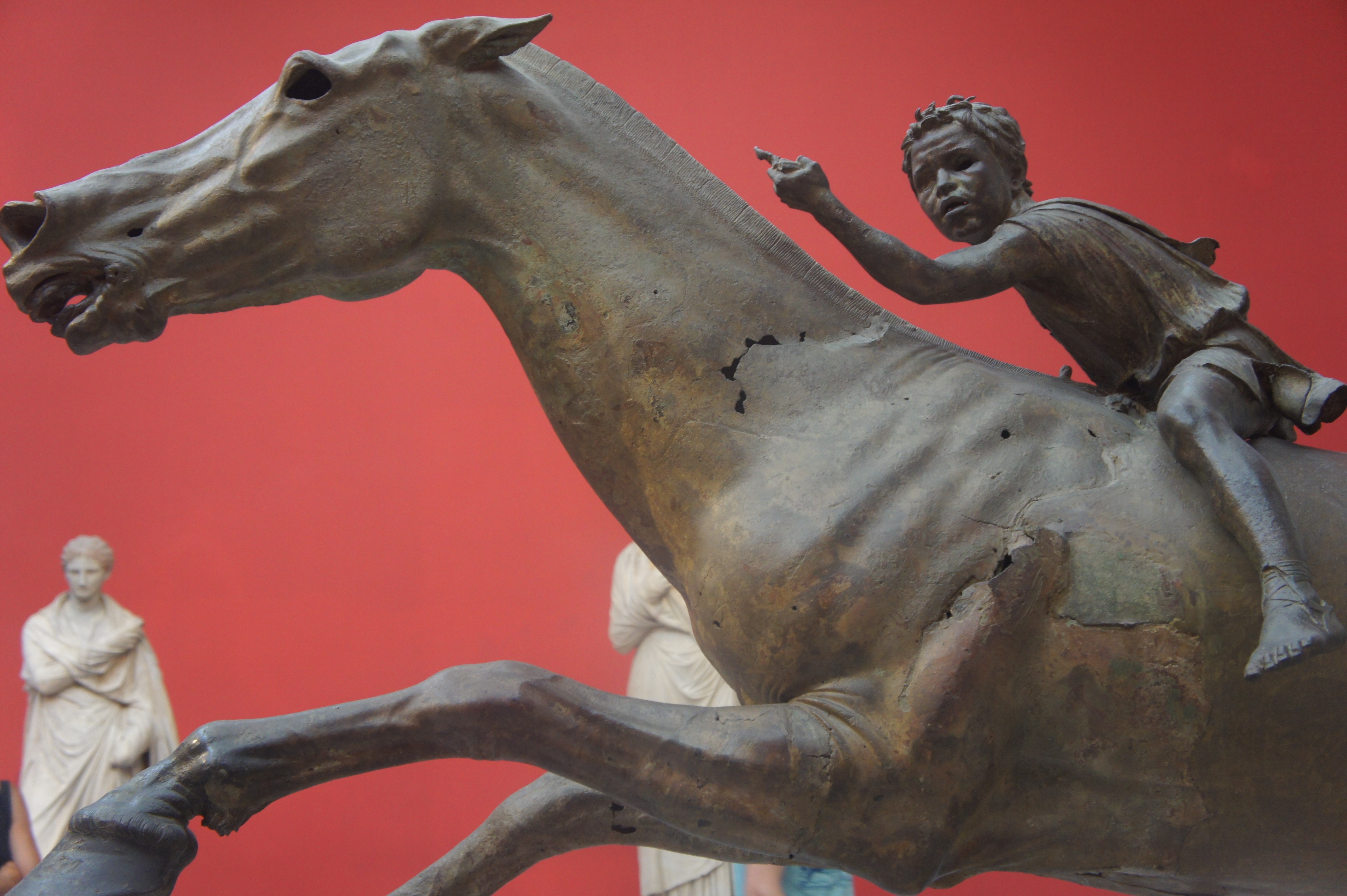
This extraordinary bronze statue was retrieved from a shipwreck off Cape Artemision in Euboea. It is called the Artemision Jockey and is circa 140BC. Photo by JE
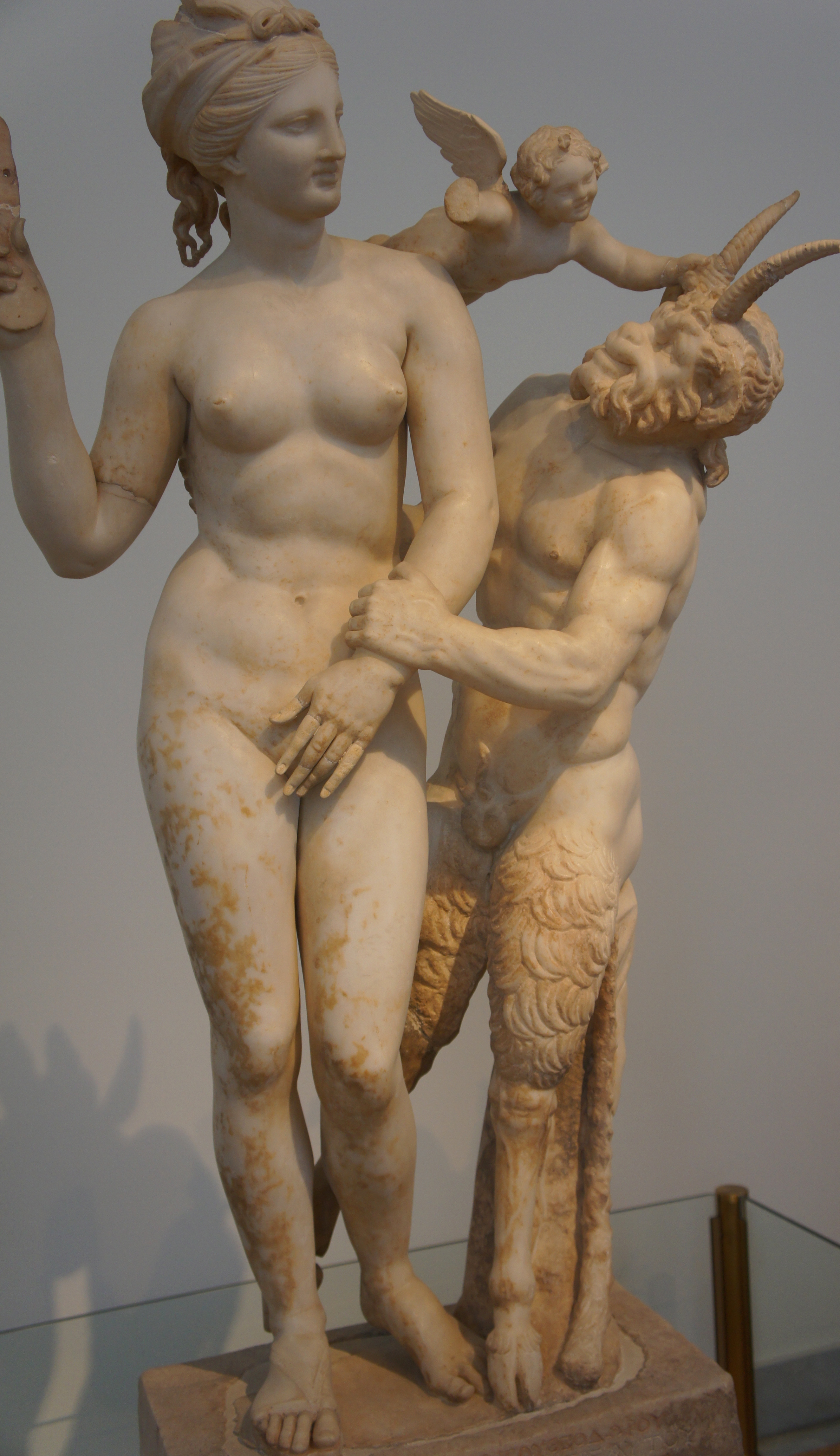
Pan is, as usual, making a pest of himself to Aphrodite with Eros helping her out. Made from Parian marble. Circa 100BC. Photo by JE who was laughing at the scene as she took the photo. Be impressed it came out at all.


This is the famous Gold Mycenean death mask known as the Mask of Agamemnon. Circa 16th century BC.
Photo by JE.

More from the Mycenean Age. Circa 16th century BC. Photo by JE.

However, what made our visit to this museum a knock-out was the Antikythera Exhibition.

The Antikythera Discopvery

A depiction of the Cousteau’s 1976 retrieval of the Antikythera shipwreck and its artefacts from the bottom of the sea. Photo by JE.

In 1900 a sunken shipwreck chokka-block full of Ancient Greek artefacts and destined for Rome in approx 60-50BC was found off the coast of Antikythera.  Many of the relics from this over-laden ship lay scattered on the sea floor.

This is the head from a bronze statue that is now known as the Antikythera Philosopher. Circa 230BC. Photo be JE.

Some of the artefacts were recovered especially bronze statues, glass bowls and ceramics, and clay pottery. Archaeologists knew they didn’t have the equipment to recover most artefacts, especially anything carved in marble as well as parts of the boat itself.
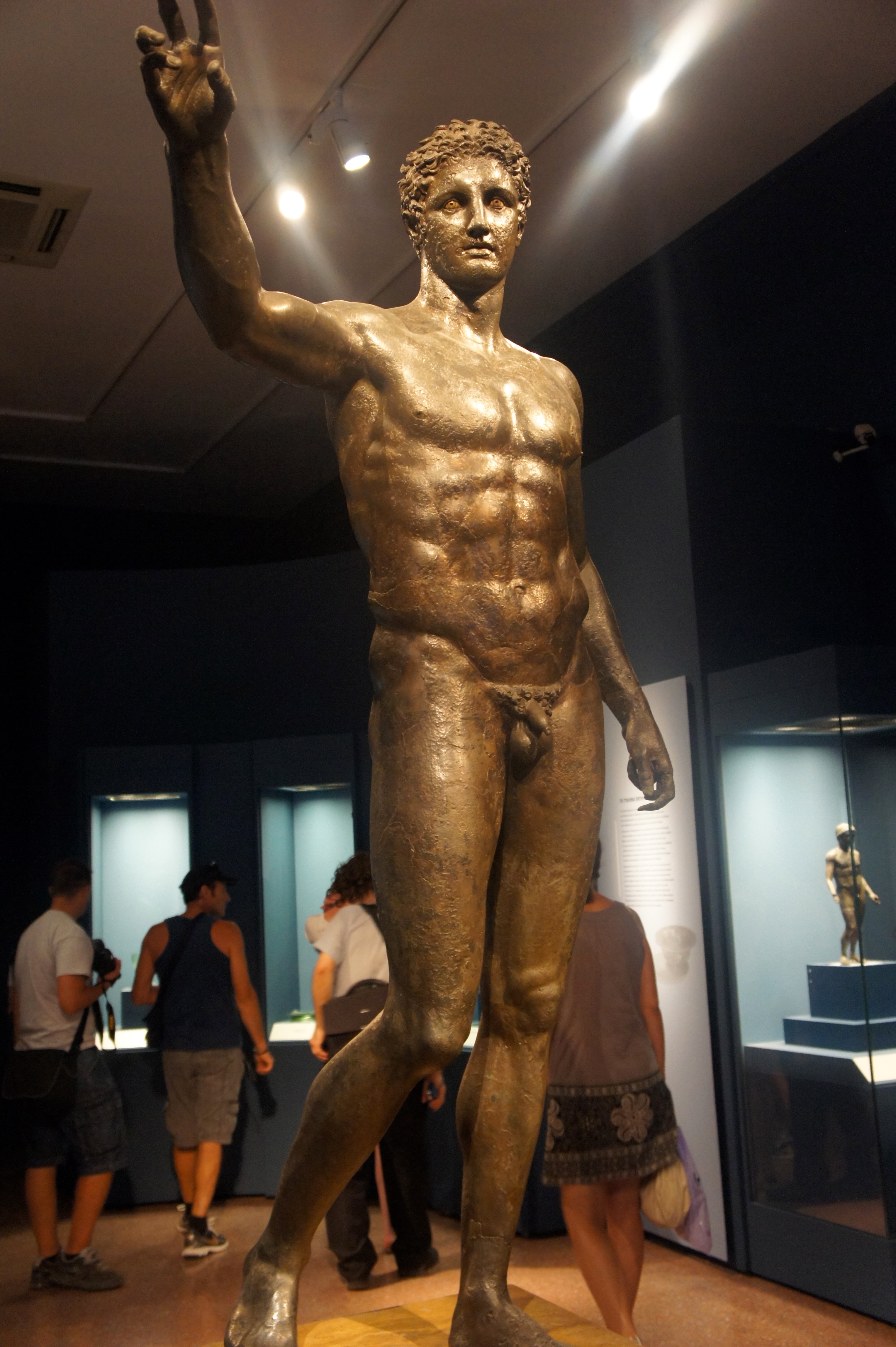
The Antikythera Youth, as it now famously known, is a bronze statue that experts date specifically to 340-330BC. There is so much speculation as to the identity of who it may be that I prefer he remains a mystery with a six-pack. Photo by JE.


In an act of blissful disregard for the bottom line, they left the vast majority of the artefacts at the bottom of the sea until they were able to recover them without causing further damage and further loss of life. A number of the deep sea divers succumbed to the bends.
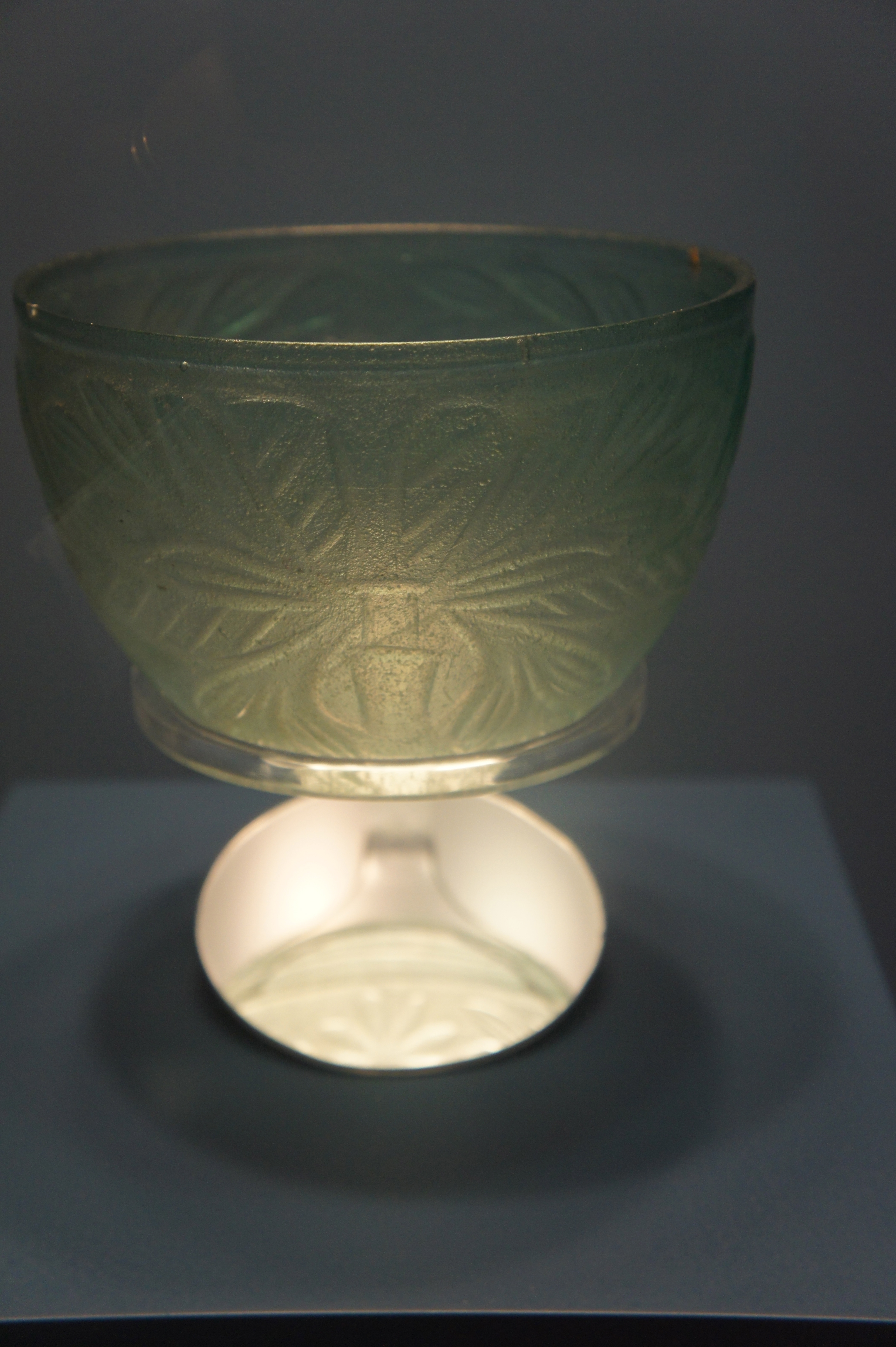
This is an amazing bowl as it is so stylised with multi-leaved olive branches over the entire surface of the bowl. Photo by JE
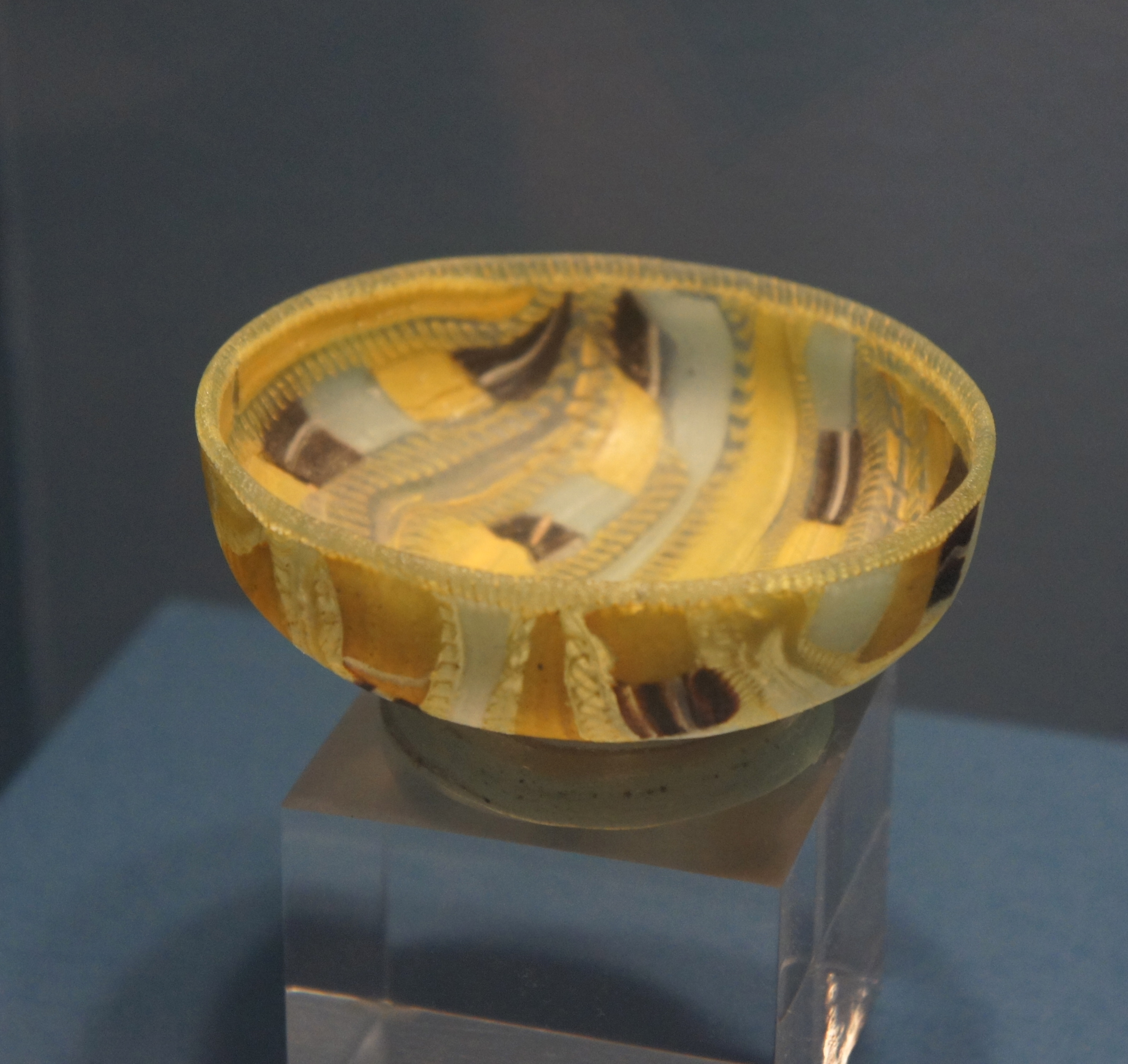
Glass Bowl from the second quarter 1st Century BC. Photo by JE.


After more than 70 years since its discovery, Jacques Cousteau was asked in 1976 by the Greek Government to lead a team to finally bring this precious find to the surface.

The  exhibits are displayed well and the story of their recovery is well told. The bronze statues are undamaged.
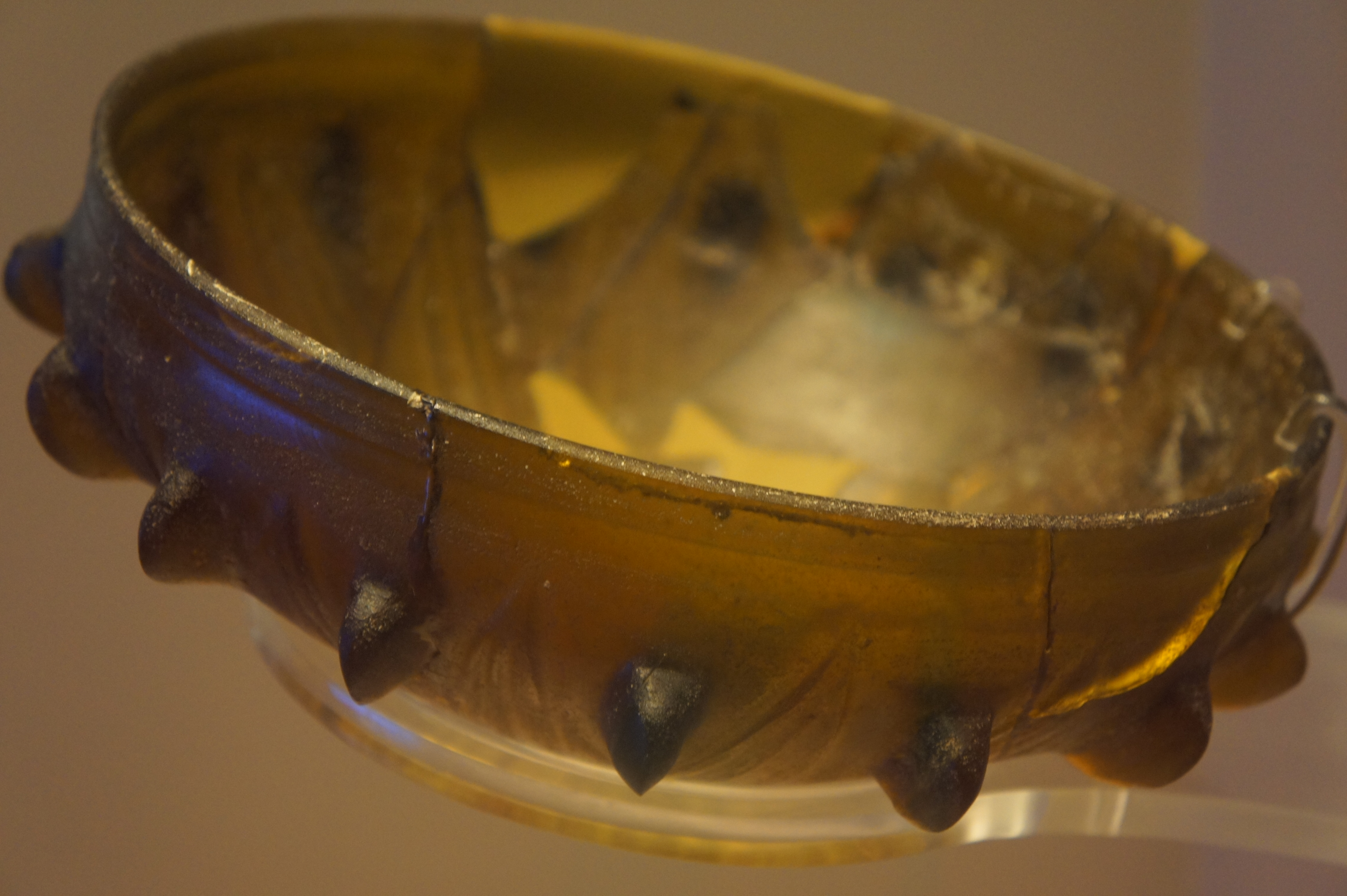
This is the largest of the glass vessels found in the shipwreck. It is from the first half of the first century BC. I wish I had something to use as a yardstick to indicate how large this bowl is. They didn’t include the dimensions unfortunately. You’ll just have to take my word for it. Photo by JE who nearly chewing gummed her phone on the glass to give it some perspective but refrained.

However, beautiful marble statues have been disfigured by the 2000 years spent underwater.

This statue of a boy is made from Parian marble and is dated in the early part of the first century BC. It is what I call one of the Jekyll and Hyde statues. The boy’s left side has been corroded by the sea organisms while the right side, buried in the sediment of the sea floor, has been preserved and is almost perfect. They are fascinating. Photo by JE.

Those parts of the statues covered by the silt of the sea floor stayed in pristine condition, while those parts remaining uncovered had been under continual attack from salt and marine life, and are damaged beyond repair. These Jekyll and Hyde statues become compelling viewing.

This statue of Hermes is disfigured almost completely except for that part of his face and head that was covered by sediment. It is dated from the early part of the first century BC. Photo by JE.

Glass bowls, jewelry and the minutiae of daily life are also on view. Some in such remarkable condition you stare in wonder.
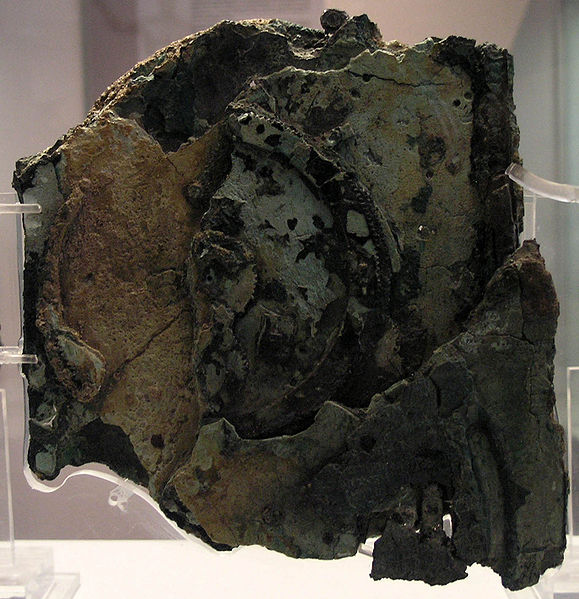
The Antikythera Mechanism. Its rear view. Photo courtesy of Wikipedia.

The Antikythera Mechanism. Discovered in 1901. It was a mystery for decades but is now called the world’s first computer. It is over 2,000 years old. Photo from Wikipedia (bless ’em).


But then you come to the Antikythera Mechanism, described as the world’s first analogue computer. It is an astrolabe. This amazing piece of technology, more than 2000 years old, is what sets the saliva going.


An astrolabe is a mechanical device which calculates astronomical positions. The Antikythera mechanism is ancient and has been dated to  approximately 80BC . It is made up of a number of interlocking bronze gears causing the main mechanism to rotate resulting in the desired astronomical information. There are theories that it was designed and built on Rhodes which was the centre of studies in astronomy, engineering and the sciences at the time. All inscriptions on the device are in Greek.

This is a model designed by Ioannis Theophanidis in the 1930’s. Photo by JE.

To underscore the significance of this one single find, the exhibition also includes a whole section on astrolabes.
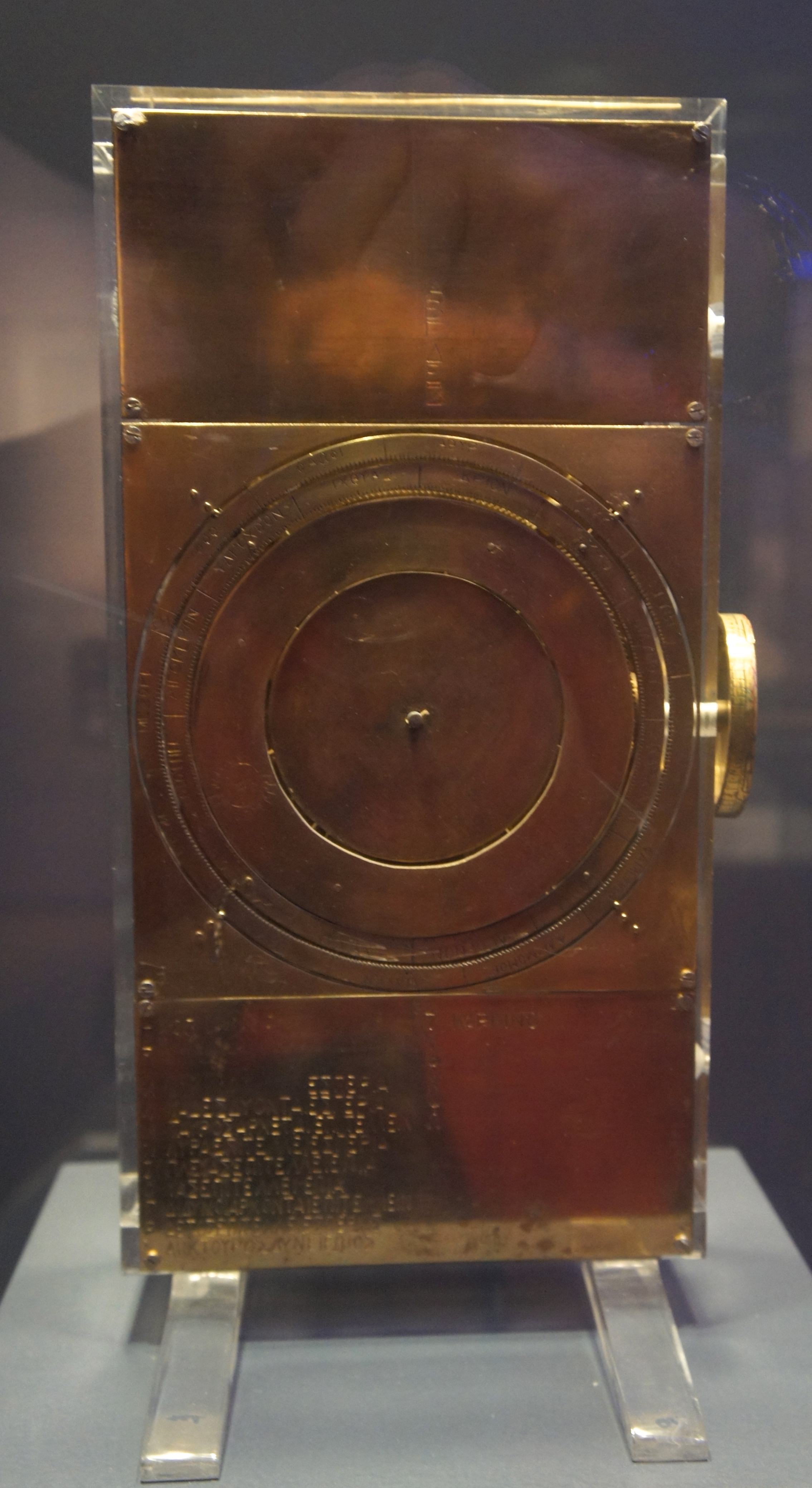
Price’s Model of the mechanism was designed by Pro Derek de Solla Price and constructed in R. Deroski in the late 1970’s. Photo by JE.


Models of early astrolabes, including Ptolemy’s, are there for the benefit of those who are intrigued by technology and not confronted by being constantly reminded that technology isn’t a modern phenomenon. Reproductions of the Antikythera Mechanism recreated by modern day nerds underscore how extraordinary this one piece is.


The academic responsible for the definitive analysis of the Antikythera Mechanism is recognised  as Pro Derek de Solla Price. The mechanism had been put away with little real understanding of what it did until Pro Solla Price first looked at it in the 1950’s. He published a number of papers but in 1959 he released a major publication called ‘An Ancient Greek Computer’. In 1974 he also published ‘Gears from the Greeks: the Antikythera Mechanism – a calendar computer from circa 80BC’. To demonstrate how he believed the mechanism worked he designed a model which he subsequently donated to the National Archaeological Museum in Athens. (see photo above).
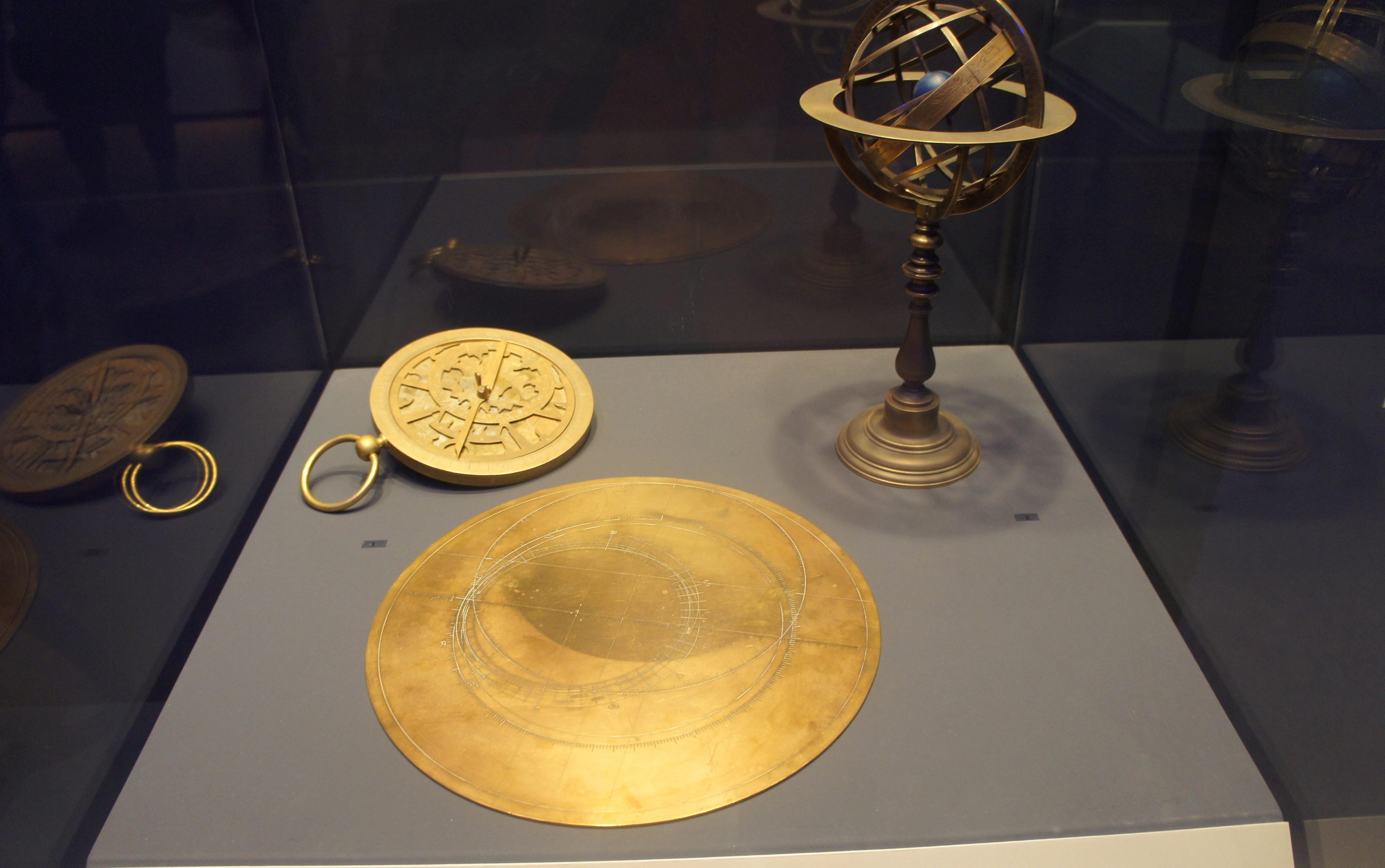
Modern replica of what is believed to be Ptolemy’s Astrolabe. Photo by JE.

You can spend an entire day in this one museum especially with the Antikythera Exhibition, which remains there until April, 2013.

Mark Colvin @colvinius kindly referred me to two short videos whose links I hope are below and successfully work. Now you know why I’ve been delaying including them in this blog post. Sometimes technology is a little overwhelming. Not, apparently, for the Ancient Greeks. Please watch these short films. They are fascinating.

This is NATURE’s video on Antikythera Mechanism Part 1

This link is to Nature’s video on the Antikythera Mechanism Part 2.

NEW ACROPOLIS MUSEUM – ATHENS

The view of the Acropolis from the New Acropolis Museum.
Photo by author.

I cannot begin to tell just how bloody hot it was. Athens in the middle of summer can be challenging at best. We approached our summer Athens stay by scheduling outside activities in the morning, and air conditioned splendour found in all museums and galleries in the afternoon.

Work on the Parthenon, Acropolis.
Photo by Me.

Visiting the Acropolis was seen as yet another of those challenges. It was so tempting not to revisit. We had been there 29 years ago, and how much could an ancient place full of temple remains have changed in that time? We decided not to be wimpish. The idea was to climb to the top of  the acropolis in the morning, have lunch and wander around the New Acropolis Museum thus occupying the remainder of the day. It was a Monday. Of course, the New Acropolis Museum is not open on a Monday. So much for the 10,000 tourists who arrived that morning on boats and whose first stop was going to be the Acropolis, and thank God for the National Archaeological Museum which opens on a Monday afternoon.

A renovated column.
Photo by author.

So armed with a gigalitre of water we walked to the top of the Acropolis. What I found  fascinating was watching the workers involved in the restoration of the whole site. So many of the statues and other bibs and bobs still being discovered on the site have been taken down to the new museum for restoration and permanent display. Large section of the columns, plinths and mantles are being restored, replaced and cleaned in all the temples. In some instances sections of the columns are being replaced. Stone masons with skills thought long gone, chisel and sand large blocks of stone with the precision required for the finished piece to seamlessly sit in its new home, underpinning vital parts of the ancient structure.

When we came down from the top the temperature was 40C and we had drunk the gigalitre of water. We were bitterly disappointed at the closure of the museum that would have expanded and explained so much of what we had seen that morning. So we found a tavern with a canopy of dense grape ivy, and huge fans that spit water all over you. Bliss. An early light lunch helped heal the wounds. The tavern’s proprietor, via the help of google in Greek and three waiters all talking simultaneously over a lap top screen, gave us the directions to the National Archaeological Museum to visit instead. But that’s another story.

Aerial of New Acropolis Museum.
Photo by Nikos Danillidis

Undeterred the following morning we returned to the base of the Acropolis to visit this amazing new museum. The cabbie who took us there vented his dislike of the new building. It’s just glass and cement was his dismissive description of the building. That is a bit like saying that the Sydney Opera House is curved with tiles everywhere. In his view it should have reflected the buildings of the Acropolis, with a heap of marble and ionic columns. Thank God he wasn’t on the selection committee. This building is as

The Parthenon Gallery, New Acropolis Museum.
Photo Peter Mauss/Esto

important to Athens as the Opera House was and is to Sydney. It is modern and makes no apology for reflecting the era in which it was conceived and built. The glass provides large shafts of natural light and the most amazing views of the Acropolis. On the top floor it seems so close you have the feeling you can almost reach out and touch it. The Museum is a building that allows the exhibits to be displayed well and with innovation. The visitor can easily walk through the history of this site and the way the artifacts are placed mean a logical and understandable meander.

The thing that pissed me off was not being able to take photographs, even without the flash. There is so much natural light a flash isn’t necessary. The only place you can take pics is on the top floor where the residue detritus of the Elgin (though don’t call them that when in Greece) Marbles are placed in the midst of reproductions of those exhibits now taking pride of place at the British Museum. You are constantly reminded of what is missing, especially when there are glass walls showing you a remarkable vista of the home from where they’ve come ‘or’ (been stolen) ‘or’ (been relocated).

Walking on glass. The entrance to the New Acropolis Museum.
Photo by author.

The museum’s entrance is placed well back from the road. As interesting as the museum is, what I personally found mesmerizing is what is happening under the building. Actually, it is what is happening under the whole footprint of the museum’s site. While excavating for the foundations of the building an entire suburb of ancient Athens was uncovered. There was a major kerfuffle as to what should be done with the cottages, homes, streets of shops,  bath houses, water systems, the whole kit and caboodle, all in a reasonable condition, given that they have been covered for more than 2000 years.

Real concern was expressed at placing foundations amidst this archaeological wonder. Great care, design changes and postponed deadlines resulted in excavation continuing around and under the building. As well as huge open wells, vast glass inserts in the entrance and on the ground floor of the museum’s foyer allow the visitor to stand on and look down at the work in progress and work completed. Their intention is to allow visitors to walk through the site after excavations are finished. I did ask when they thought that would be. The answer was always ‘soon’, which I think is Greek for ‘how long is a piece of string?’

A view down below at the excavations seen through glass.
Photo by author.

Be warned. If you suffer from vertigo you would be best advised not to walk on the glass floors, rather skirting them at the edges. They are an unexpected distance from what is happening down below. His Nibs suffers from vertigo and he estimated he was

A work in progress. Excavations under the New Acropolis Museum, Athens.
Photo by author.

20-30 feet off the deck. He persevered, but it did make him feel slightly nauseous. It didn’t worry me a jot so I wasn’t conscious of how far down I was looking. I was too busy working out floor plans and exclaiming over drainage systems.

The large open well showing excavations in progress under the New Acropolis Museum, Athens. Photo by me.

Lunch was on the 4th floor cafeteria with a huge outside area which looks at the Acropolis and the surrounding and seemingly very ritzy residential area. The food is adequate, the coffee excellent, the view worth it. If you are a fan of Museum Shops prepared to be be disappointed, although they did have a impressive reproduction of a bust of Sappho.

Because I was unable to take photos of the exhibits in situ I have included some photos from the official Museum site and Wikipedia (bless ’em).

Part of the original Parthenon Marbles, New Acropolis Museum, Athens.
Photo by author.

This is the link to the official site of the New Acropolis Museum. What this link does is show you the plan of how best to walk through the Museum. It’s laid out in galleries and makes it easy.

http://www.theacropolismuseum.gr/?la=2

This is a link to a mountain of photographs from the New Acropolis Museum. You may like to wander through it.

http://www.google.com.au/search?q=new+acropolis+museum&hl=en&client=safari&tbo=u&tbm=isch&source=univ&sa=X&ei=3JtMUPrhGOmhigfdjIDoDA&ved=0CG4QsAQ&biw=1024&bih=672

Do yourself a favour and look at the slideshow of 16 amazing photos of the New Acropolis Museum as published in the New York Times.

NB: The New York Times link I can’t activate on my blog but it works. Copy or cut and paste the bloody thing. There are 16 of the most magnificent photographs presented in a slide show. Once you’ve seen them you’ll understand why I compared the importance of this building for the cultural soul of Athens and the on-going campaign for the return of the Elgin Marbles, to the Sydney Opera House.

This is a link to Christopher Hitchen’s piece on the New Acropolis Museum. He wrote this article for for Vanity Fair not long after the museum opened. I’ve included it because he makes a case for the return of the Elgin Marbles far more eloquently than I ever could. His reaction is intellectual, mine far more physical.

http://www.vanityfair.com/culture/features/2009/07/hitchens200907

This is a link that looks at the site from the architect’s perspective. It includes schematics, plans, as well as other more technical information that may be of interest.

http://www.arcspace.com/architects/Tschumi/

Enjoy.

The next blog posting is on the National Archaeological Museum. You can go ho hum if you like but it contains a swag of stuff on the Antikythera Wreck which is on exhibition there.


Sent from my iPad

A LETTER TO AN ADVERTISER – a little old lady destroying the joint.

This is an email I sent to one of the companies with whom I’ve done business over the years, who advertise on Alan Jones’s programme. I was so outraged with Mr Jones’s comments that I felt compelled to do something, no matter how small and ultimately insignificant, other than just rail against the day.  I’m just an ageing lady #destroyingthejoint through the power of her wallet. It would be advisable for companies to remember that women control the vast majority of decisions when it comes to consumer spending, even the family car.

sales@renovationboys.com.au

Dear Boys,

RE: ADVERTISING ON 2GB’S ALAN JONES.

Last week Alan Jones directed a diatribe, which was misogynist. It has been publicized that you advertise with Mr Jones.

The great thing about living in a democracy is that you are permitted to advertise with whom you please. Another aspect of this freedom is that I can chose not to continue doing business with those companies who make that choice, and I have the freedom to publicly explain why.

I have supported your company for many years now, but will not do so in the foreseeable future while you continue to advertise with a shock-jock who maligns targeted groups within our community as he did last week. (see link below).

At some point a line in the sand must be drawn indicating that such comments are offensive, incendiary, divisive and unacceptable in a civilized society. That line was crossed last week.

For your information I have two bathrooms and fittings for a further three bathrooms to purchase in the next year.  I will look and purchase elsewhere.

Please give my very best wishes to all those members of staff who, over many years, have given me such brilliant and patient service.

If at anytime you no longer advertise with Mr Jones please contact me, and I shall be only too happy to not only resume shopping with you, but also happily publicise that fact through my blog and on twitter.

Yours sincerely,

Joan Evatt.

4th September 2012.

bit.ly/NAf4By.webloc  Alan Jones’s comments on women.


Ephesus

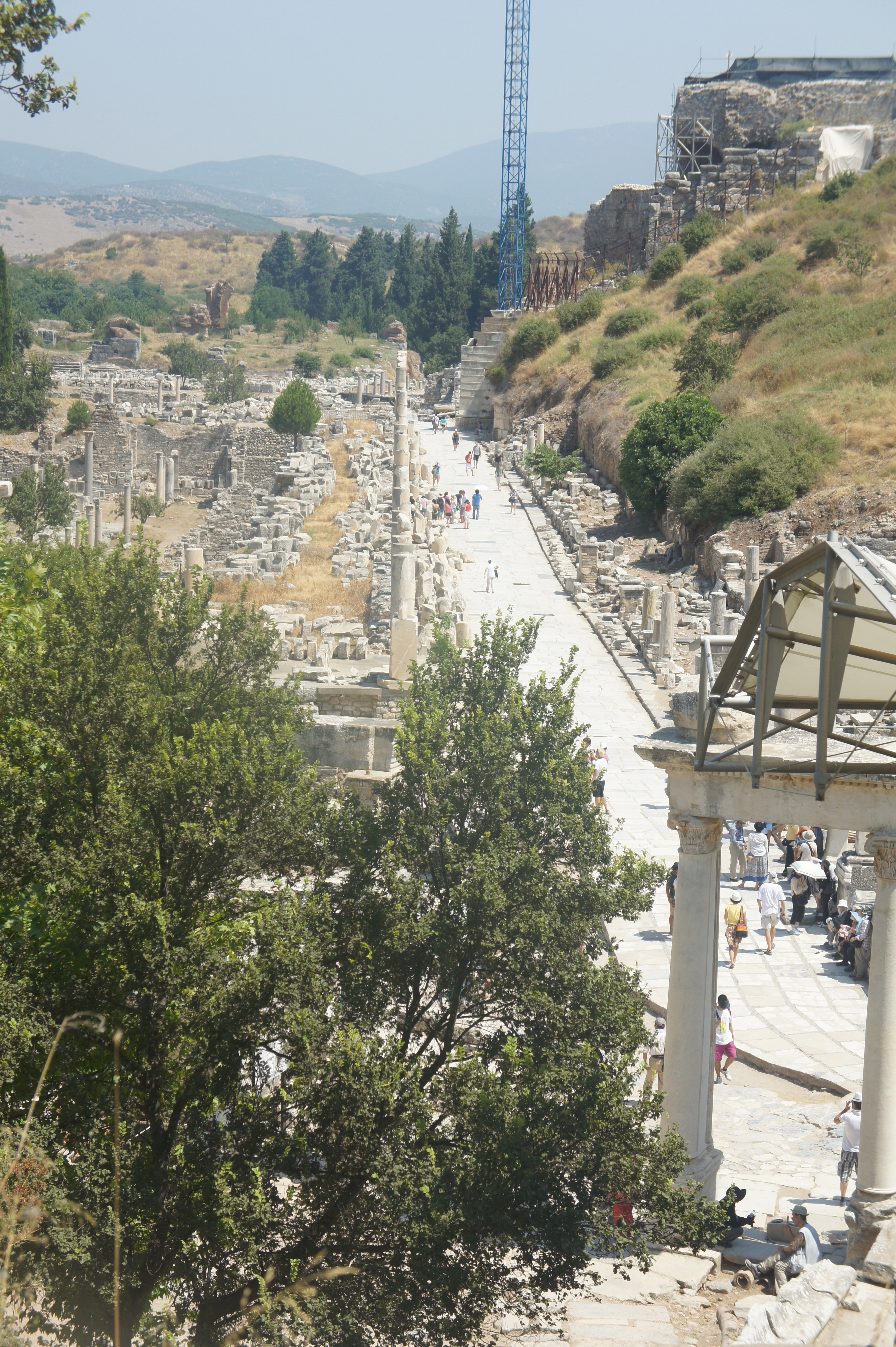
The main street of Ephesus.

When you ask kids what they want to be when they grow up most want to be rich, ballerinas, firemen, actors, policemen or something equally exciting. Of course a lot depends upon gender influences. Me?  I wanted to dig up Troy. The fact that it had been discovered and had already been dug up, being kind of ruined in the process, didn’t faze me a bit. What fazed me was when I learnt that to be a really good archeologist required a knowledge of Latin and a healthy smattering of Ancient Greek, and so my dreams came to a shuddering halt.

I never thought I’d see Troy or Ephesus or Pompei. They’re places you read and fantasise about but you never, in your wildest dreams, expect to wander through their ancient streets, gazing at views that haven’t changed in thousands of years.

Ephesus has increasingly become a must-go-to-see tourist attraction, which can be a monumental pain in the arse.  It is not helped by bearing witness to what little remains of the Temple of Artemis, and street peddlers with signs that read “Genuine Fake Watches’.

View of a part of Ephesus from the upper outside area of the villa currently being excavated. You can see a crane working on the arena in the distance.

His Nibs and I were most fortunate in having a personal guide, Nurdan,  a retired curator with the wonderful National Archeological Museum in Istanbul, who had worked on the site for nearly three years helping uncover mosaic floors. It was, for her, a labour of love.

One of the mosaic floors recently uncovered with assistance of Nurdan, our guide, and located at the front entrance to the villa currently undergoing excavation.

The other mosaic floor recently uncovered. Ephesus.

Ephesus is famous as being; first, an ancient Greek and  then a Roman city of distinction where sons of Roman noble families were sent for their education. Under the Romans in the 1st century BC the population is said to have been around quarter of a million, and close to 400,000 by 100 AD.

The city had hot and cold running water via clay pipes that fit together like lego, and are seen in abundance everywhere on site.  Fire ovens where water was heated have been found when excavating the bath-houses and those houses which had baths.  They also used hot water for heating.  Very civilised.

Clay water pipes in situ. Ephesus.

Excavations of nearby areas have unearthed artifacts from the Neolithic and Bronze Ages, meaning there has been some form of settlement here since approximately 6,000BC.

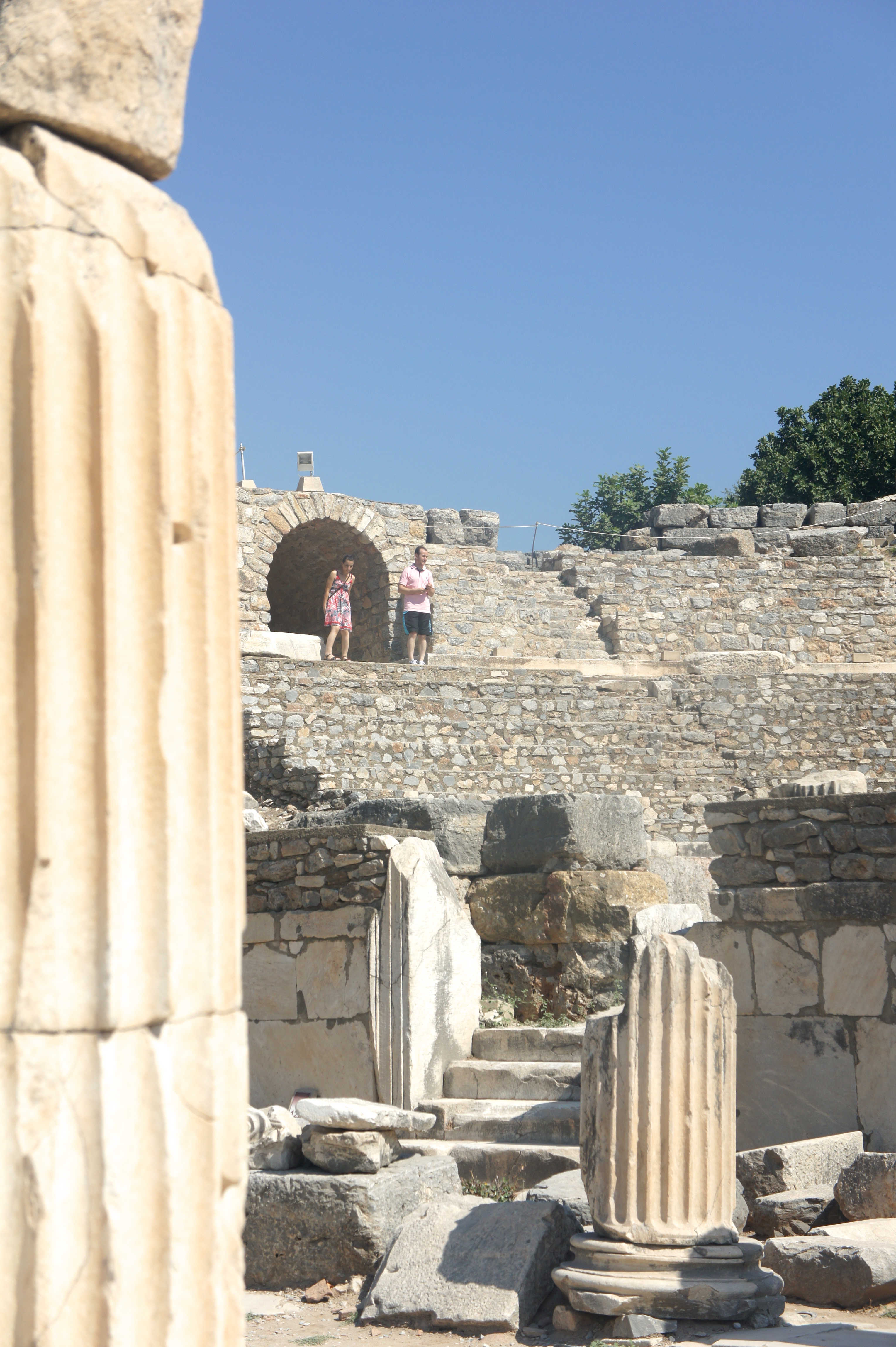
A section of the Odeon. Ephesus

This city was important during the Classical, Hellenistic and Roman periods. Its major temple, the Temple of Artemis, is deemed to be one of the Seven Wonders of the ancient world. It had been damaged and rebuilt a number of times, the last rebuild being completed in approx. 550 BC. The temple was subsequently destroyed by John Chrysostom in 401 AD during yet another period of destroying anything that smacks of paganism or heresy.  He became a Saint.  Whether this canonisation was because he destroyed one of the seven wonders or for other nefarious reasons I neither know nor care. May his relics be so scattered throughout the Christian world that it gives him no peace in his special after-life.

The Temple of Artemis now boasts only one poor lonely column remaining. All other artifacts now reside in either the British Museum or the National Archeological Museum in Istanbul.

The obvious destruction of the Temple of Artemis is a sorry start to the day but is soon catalogued somewhere in the back of your mind as Ephesus is amazing.

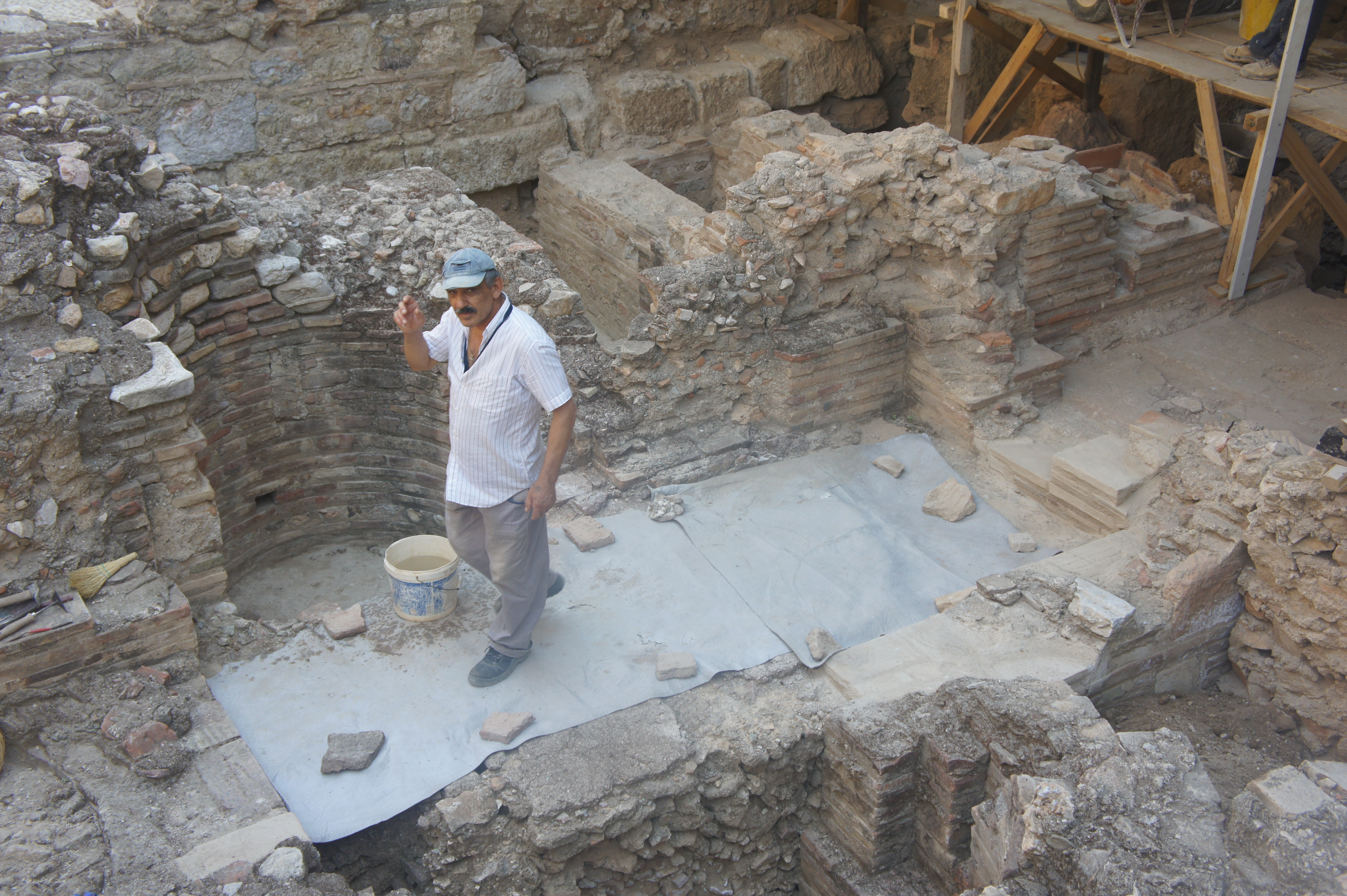
Interior of an on-going excavation of a villa. Ephesus.

They estimate that nearly 20% of the city has now been uncovered. To be able to walk the streets of Ephesus as it is now is special. We were, however, fortunate enough to receive a special privilege of going through one of the homes that is currently being excavated.

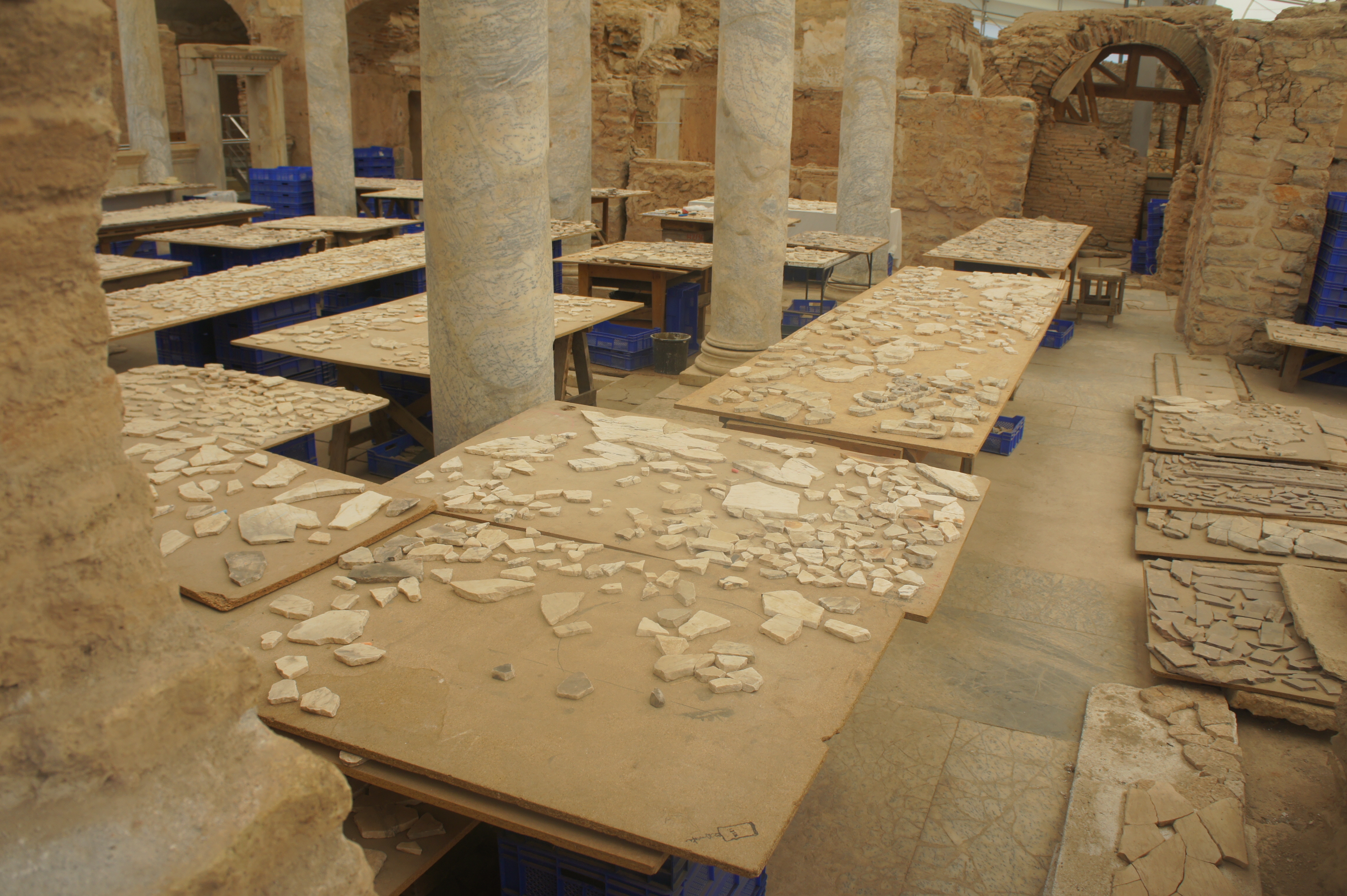
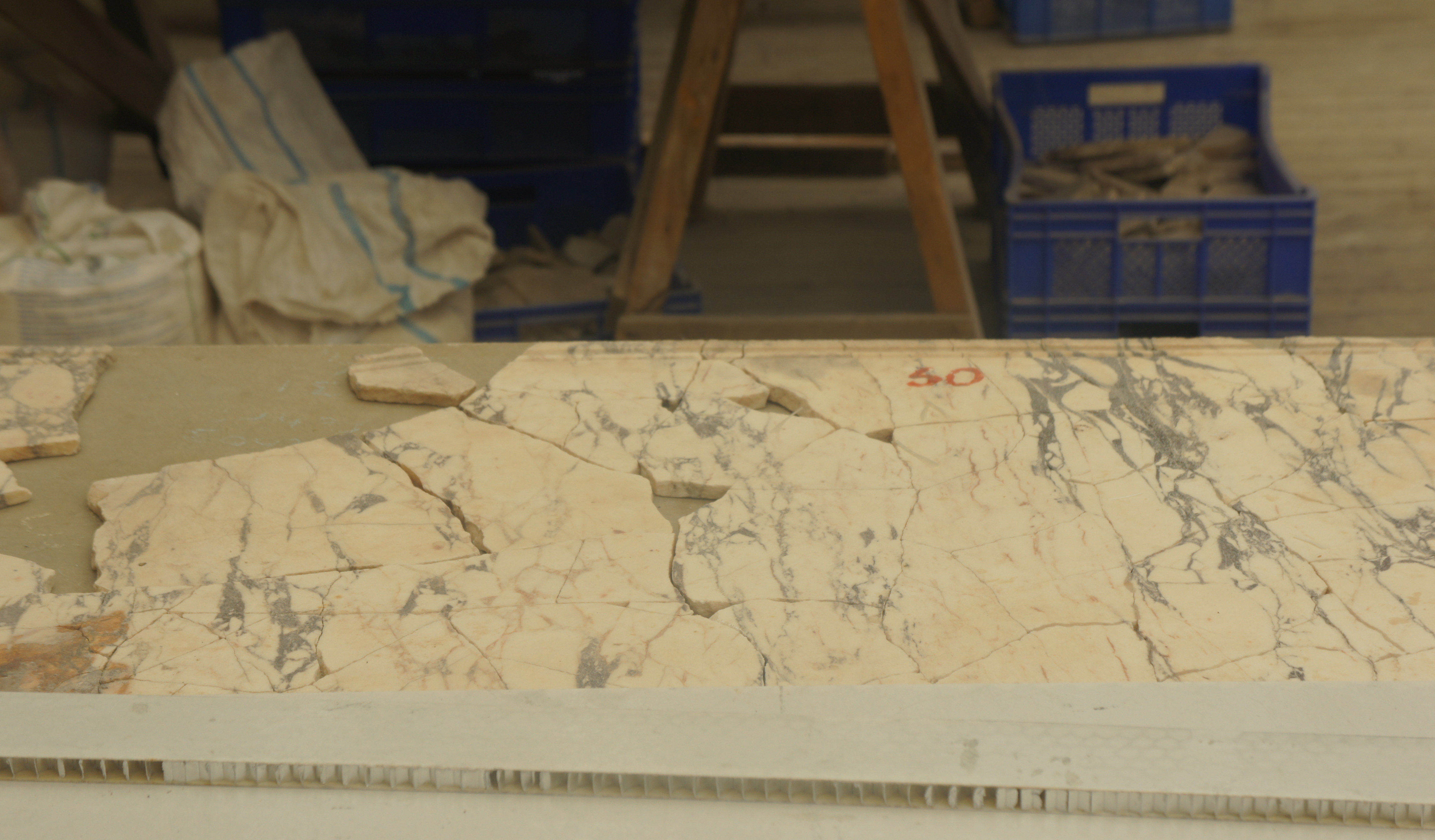
Anyone for some jigsaw puzzle practice? Work continues. Ephesus.

They have carefully built a large tin shed around the villa that once took pride of place on the main street of the city. This allows those archeologists working on the site to continue working uninterrupted from either the thousands of tourists who visit or the weather, which can be daunting. The day we visited Ephesus it was over 40C. Working in the direct sun would have been impossible.

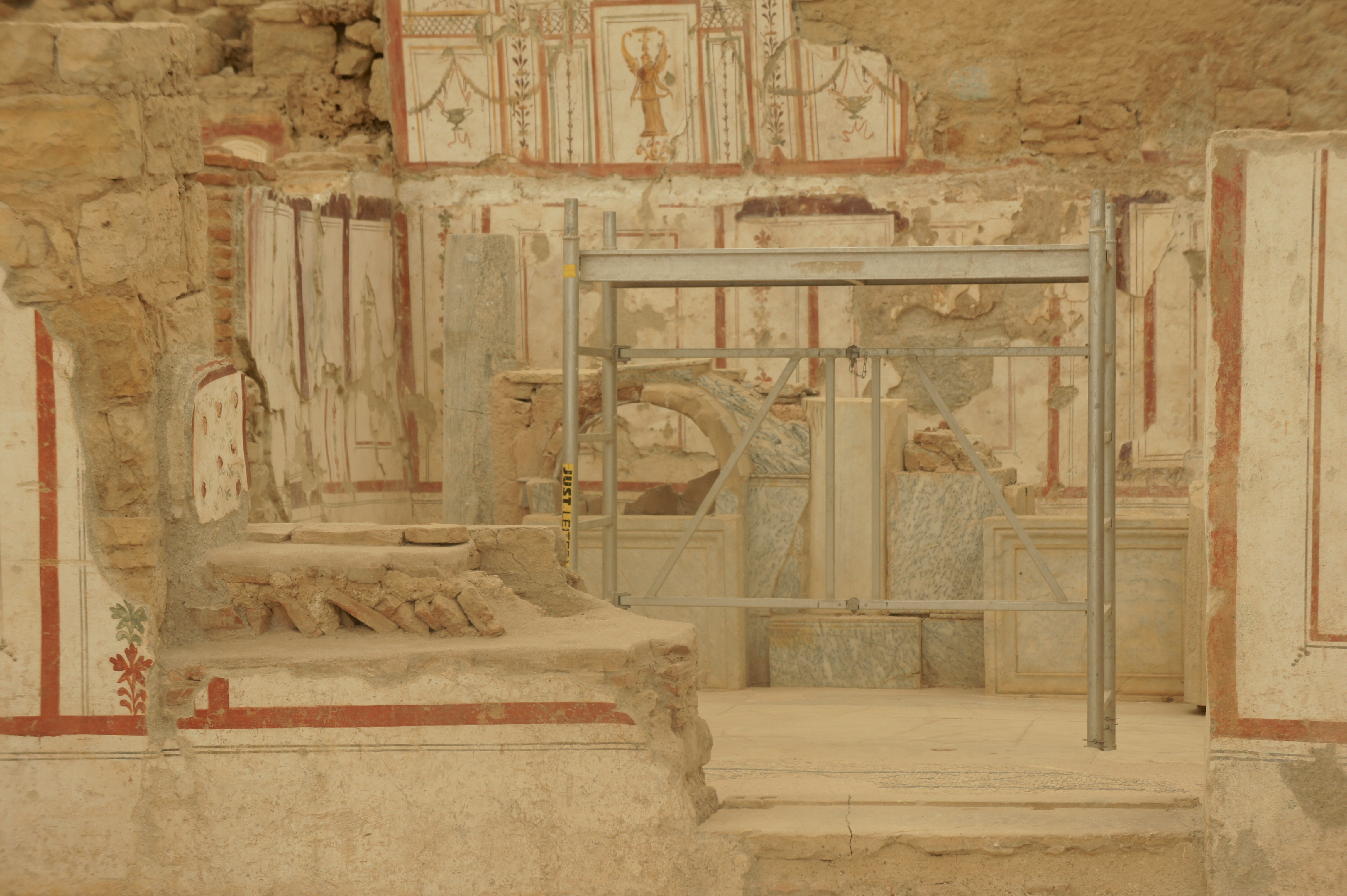
Fresco: a work in progress.. Ephesus.

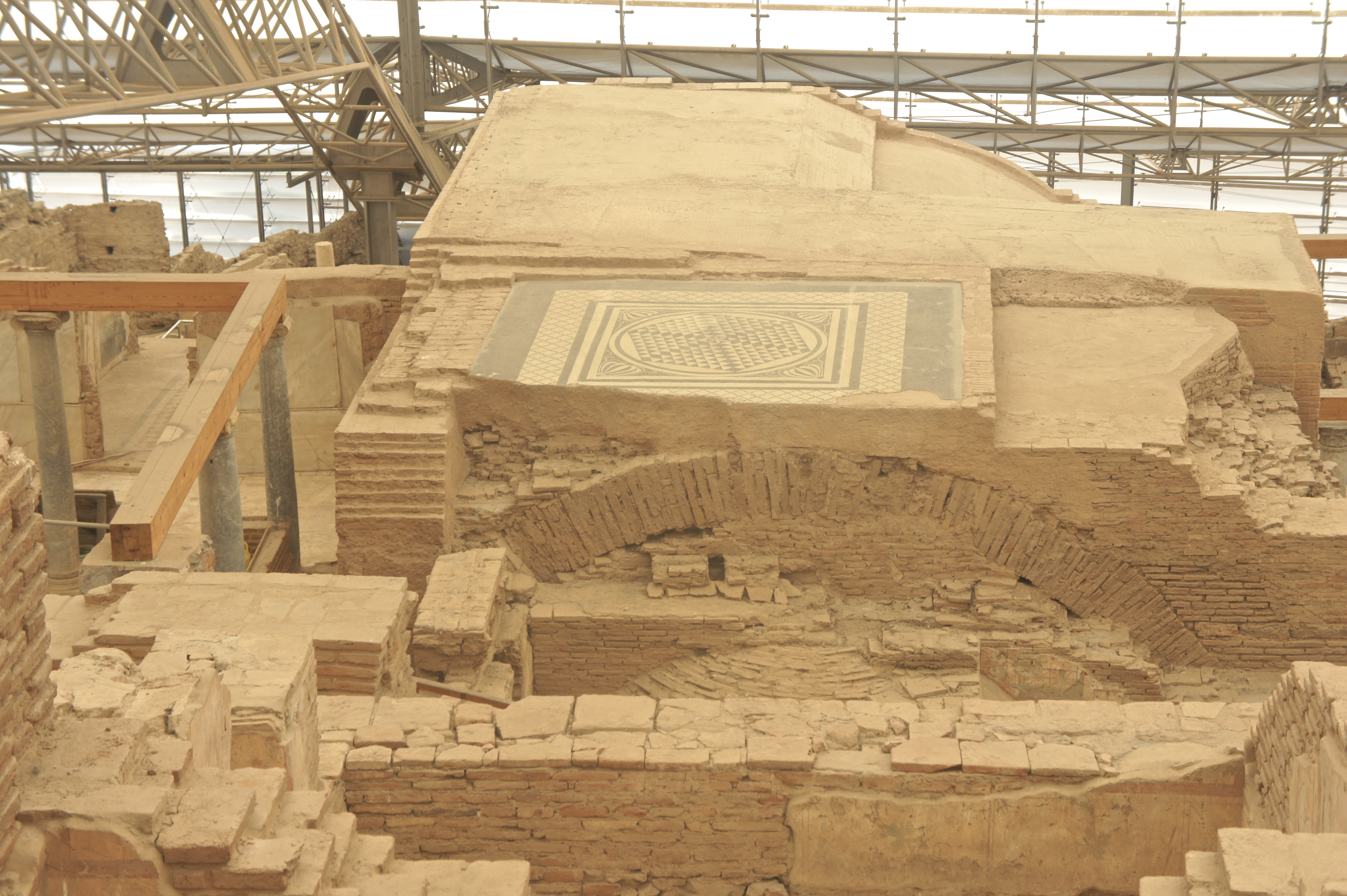
Mosaic floor in situ. Villa. Ephesus.

We spent ages looking at what has been accomplished here. Floors have been uncovered, baths, huge ovens for heating water, as well as water and waste pipes – all gravity fed, ventilation shafts for the movement of fresh air, frescos, mosaics and artifacts of urns, statues: a treasure trove in comparatively good condition.

Part of the bath. This villa had their own bath. Ephesus.

Water pipes uncovered and remain in situ. Villa. Ephesus.

Large trestle tables are set up, one after the other, as pieces of marble, stone and tiles are uncovered. If you have a penchant for jigsaw puzzles there’s a job waiting for you here.

The sub-floor engine room for the whole house includes pipes for running water, and ovens to heat water. Ephesus.

The other big ticket items of Ephesus are the Library of Celsus, which is a gobsmacker, and the main arena.

The facade of the Library of Celsus is deliberately designed to create an optical illusion. The columns are tapered in such a way as to cause the observer to believe that the building is larger than it really is. It is quite a small building in fact although it is reported to have held over 10,000 “books”.

The facade of the Roman Library of Celsus. Ephesus.

The Library was designed and placed in such a way as to maximise the amount of light entering, what the archeologists believe, were the reading rooms.  As you reach the top of the stairs there are four fabulous statues. One being the namesake for our daughter I had to include a photo of course. I’ve also tried to take a photo which shows how the columns are tapered. I don’t think I succeed but it is included. for your perusal.

One of the statues that grace the front of the Library of Celsus at Ephesus. Her name is Sophia.

The facade of the Library of Celsus at Ephesus. The columns are tapered creating an optical illusion that the facade is bigger and more imposing than it really is.

As the Library dominates the walk down from the main gates, the arena becomes the focus of attention when you reach the end of the main street. They are currently working on it. A huge crane is required to replace the large stone blocks. Depending on who you speak to or what publications you read, the arena can/could seat 25,000 to 40,000 people. Either way it is vast. The controllers of Ephesus now light the city at night and I’m told it is spectacular. Now that would be a sight worth making a special return trip to see.

The glorious arena of Ephesus.

MY SPAGHETTI MARINARA

My Spaghetti Marinara

My Spaghetti Marinara
Photo taken by me.

My first cook book was the Commonsense Cookery Book which was the high school text for the compulsory cooking classes all girls had to endure back in the dark ages when I went to school. I remember the first cooking class I had as a 13 year old in which we made savory mince. It was a glutinous inedible mess. Those classes were unspeakably dreadful, as were the  compulsory sewing classes.

The delight I take in cooking probably comes, as it does with most foodies, from watching a grandmother or mother bake, helping out at the appropriate times, and licking the bowl as part of the process. What has always staggered me is that my school’s compulsory cooking classes didn’t turn me off cooking for life. It certainly did with sewing. To this day I refuse to even sew on a button.

I threw away the Commonsense Cookery Book decades ago as a hated reminder of those awful days.  It was a foolish thing to do as this cookbook was a treasure trove of old- fashioned quintessentially English recipes. I know of at least three or four recipes that I want to try. They were, of course, contained in that book. It means I’m going to have to explore Berkelow’s or Glebe Books in an attempt to track down a second hand version. The extraordinary thing is it’s still in print.

The second cookbook in my life was the Australian Women’s Weekly Cookbook. I gave it to His Nibs as a wedding present much to his amusement as well as that of our friends. He become a reasonably good short order cook, and used to make an apricot souffle which was delicious. Some 40 years later the same tattered and food stained copy of the Australian Women’s Weekly Cookbook complete with imperial  measurements and notes in the margin, is dragged from the shelf for occasional use.

This Marinara Sauce originated in the Australian Women’s Weekly Cookbook, but like most recipes I use there are quite a few amendments and additions made over the decades. But like all Australian Women’s Weekly Cookbook recipes I’ve ever tried, it is fail safe.

METHOD

  1. 200 grams green prawns
  2. 100 grams baby octopus
  3.  100 grams of scallops
  4. 100 grams smoked mussels (you can buy these in a container usually swimming in marinade, rinse them thoroughly before using them.  You need to get rid of the marinade flavour as it can be very vinegary,  but these smoked mussels are to die for).
  5.  100 grams of fish (your choice). I use flake. It is strong, doesn’t disintegrate during the cooking process, and takes on the flavours of the other seafood.
  6. 30 grams butter
  7.  Red Onion, chopped finely
  8. 1 clove of garlic, crushed
  9.  1 can crushed tomatoes
  10. 2 tablespoons tomato paste
  11. 1 cup stock
  12. 1 dessert spoon sugar
  13. tablespoons parsley, chopped
  14. 1 tablespoon  basil, chopped
  15. 1 dessert spoon mint, chopped
  16.  400 grams spaghetti ( I have to confess when I made this the other night I used an entire packet of spaghetti, all 750 grams, and there was plenty of sauce. There were five adults who had had a very long day, and we were all slightly peckish).

METHOD

  1. Chop up all the seafood ingredients into small bite size bits with the exception of the mussels and the scallops.
  2. Melt the butter and add the onion and garlic and cook until the onion is soft.
  3. Add the can of crushed tomatoes, tomato paste and stock. Bring to the boil then simmer until the sauce has been reduced and started to thicken. This should take about 10-15 minutes. Add the sugar (it tempers the acidity of the tomatoes).
  4. Add your seafood, starting with the chopped octopus, a minute later add chopped fish and prawns, then finally add the scallops and mussels. All up it will take 3 minutes or so. Turn off the heat and add the herbs stirring them through the sauce, leaving some extra parsley as pretty garnish.
  5.  Pasta should be cooked in accordance with the instructions on the packet, or if fresh from shops such as the Pasta House in Leichhardt, you will find that it takes only 3 minutes of so to cook. Drain the pasta. Serve the sauce over the pasta.
  6. Add parsley garnish.

I know that it is not de rigueur to add cheese to a marinara dish, but there is always some ground Parmesan cheese on my table for those who like to add it into the mix. We also have lovely local crusty bread to go with it.

On the matter of wine His Nibs says to have a chilled Rose if you’re having this dish in the summer.  In the winter he tends to choose a pinot noir.

This photo was the finished dish before all five of us fell on it. There wasn’t so much as a strand of spaghetti left. I know. Oink! Oink!

Enjoy. We did.

THE GOOD AND THE BAD OF TWITTER

With the death of the amazing @no_left_feet and the demise of #artwiculate I’ve spent the last 24 hours alternating between crying my eyes out and being so angry I could spit chips

Twitter has been an illuminating experience for me. I would never have thought it possible that within the 140 character construct, you could develop friendships that are every bit as strong and meaningful as non-cyber, life-long, real friends.

Because twitter is an open, uncensored slather, just like life itself, you have to deal with the best and the worst in society. The goodies shine through with an aura which makes them so special.

The bad are those who are bullies and racists, who are driven by negativity and a real desire to spoil, who can and will make life difficult for those of us who just want to have fun, be better informed, be entertained, be stimulated, and be open to all possibilities

This has been the case with #artwiculate, a daily word game that cluttered time lines throughout the world with wit, hilarity and extraordinary cleverness. It was my early ventures into this game that unexpectedly resulted in good friends being made; some I’ve met in the real world, some I intend to meet and others if I can possibly organize it. These friends on twitter have become part of my daily life.

As a result of the constant barrage from trolls who are cyber’s equivalent to vandals and bullies, the artwiculate site has been closed. It is a helluva shame. I don’t blame the artwiculate site creators who, at their own personal cost, have run the site for three years, have had to put up with their site being hacked in the last few months, as well as also being the recipient of the abuse generated by one or two.

See previous blog post

This does give me a chance to thank those artwiculate players with whom I’ve connected over the past 10 months or so.  I’m grateful for their patience as they taught me how to index (thanks Viv, Liv, Elisaki and George), changed my avi when I couldn’t, and put up with my random musings often with expletives undeleted that should have offended and never seemed to.

It was through artwiculate I came across @no_left_feet, also known as @one_right_foot. I only knew her as Hops. I didn’t know her name until yesterday when I read about her death at the age of 36.

Fuck, she was funny.

At no stage did her illness seem to taint the approach she brought to twitter. She was always on for a game. When she released the news a couple of months ago that her cancer had returned she remained positive and upbeat. If anyone was going to beat this it was going to be Hops through the power of laughter.

I always sat back when I saw @designarhyme and Hops on my TL as I knew I was in for a laugh a minute ride watching two master wordsmiths at work. It was like watching two duelling fencers. Rhyming couplets at ten paces. It didn’t matter what was the subject matter, the rhyming duel was on. It was flirtatious, clever, apt, often very naughty and always very funny. I got caught up with them a couple of times when I’d be rhymed out after 3 or 4 attempts and I’d sit back, follow their conversation, and roar with laughter until I’d snort, which is especially embarrassing if one is drinking coffee at the time.

How you set about explaining to a group of tweatherns (thank you Silia), people who don’t tweet, that you are crying for a woman you’d never met, whose real name you never knew and who lived on the other side of the planet, is not easy.

The attempted explanations are a real indication of what is good about twitter, and what was good about #artwiculate. There is a  sense of community devoid of the boundaries that usually divide. Boundaries of nationality, ethnicity, religion, class or life experiences become irrelevant, and instead are replaced by the shared joy of life in general, and word games in particular.

This joy of life Hops had in buckets and is why we all recognise just how much she will be missed.

If you want to see evidence of the good in this social networking world we call twitter then connect via the link below, to a collection of tweets starting off with an ode to @no_left_feet written by @designarhyme, as well as other contributions from across the planet courtesy of the compilation work by @milesorru

https://twitter.com/#!/milesorru/status/202370037238071296

#RIPAmanda #FuckCancer

Digby Wolfe: 1929-2012

Digby Wolfe. c/- SMH

Recollections.

Every now and then the phone rings. It will be a call that can be life changing or open up possibilities for an unexpected journey that enriches the soul.  In August of 1980 I received such a call. It was from Faith Martin, an old friend and one of the nicest and most generous people in the Australian film and television industry. She asked me to send over some of the longer human-interest stories I’d done while working at Channel 7 and Film Australia. Send them I did.  She rang to tell me that Digby Wolfe had a project in mind, had seen my stories, wanted to meet me, and was I interested.

Was I interested?!  Digby Wolfe! You bet.  The first time the name Digby Wolfe entered my consciousness was in the TV show Revue 61 and 62.  My mum was a huge fan.

Off I went to meet Digby. He really was a very good-looking man with a ready smile, firm handshake all wrapped up in an urbane elegance.  But it was his extraordinary blue eyes that struck me. They twinkled and were full of intelligent understanding. Whether you were in a one on one chat in an office or in the middle of a crowded room, Digby would focus only on you and not scan the room to see who had arrived. He had the happy knack of making people feel special, and that whatever you were talking about was so very important it required 100% of his attention.

He was putting on a show. The show’s premise was that every person has at least one good story to tell and we would facilitate the telling. He criticized my existing TV reports because there was very little of me in them. I regarded that as a compliment. I had learnt in an earlier era that if journalists removed themselves from a story, leaving the talent to tell it, they had done their job well.

Digby’s show was going to do the opposite. The interviewer was going to be as much the ‘star’ as the subject of the interview.  He talked about what he wanted to do.  I listened.  I said yes.  I knew that the show would thrust me back into the spotlight for a time, a place in which I’ve never been comfortable, but after my first meeting with Digby I also knew I wanted to work with this man.  My job interview descended into a multi-hour chat primarily about politics, both domestic and international.  Digby was passionate about politics, and any chat would always turn to the current political situation.

Robyn Nevin, Digby Wolfe and me. Photo: Kimbal Baker

The 10 months pre-production and production period, before the show was unceremoniously dumped because of poor ratings, was the happiest work experience I’ve had in my eclectic career.  I worked with the most amazing group of people both in front of and behind the scenes, including Faith Martin, Ray Taylor, Robyn Nevin, Col Joye and Sarah Grant. Frank Hammond, Jebby Phillips, Dennis O’Brien, David Mitchell, Wil Davies, Roseanne Andrews-Baxter, on and on, writers, producers, editors, shooting crews – a funny, warm, generous group of people.  It was a pleasure to go to the production office. There was always the sound of laughter, quick-witted banter, political discourse and the work.

You can tell the measure of a man when he is a boss who inspires loyalty freely given, provides a working environment people break their neck to be in, and who maintains enduring friendships.  That was Digby Wolfe.

Not long after he returned to LA. I had my first child naming her Sophie. I received a telegram from him saying “Agh. A perfect choice”. I had no idea what he meant so I replied “But of course”, hoping that this telegram missive would cover all bases. Unbeknown to me a film was about to be released called ‘Sophie’s Choice’ based on a novel I should have heard of but hadn’t. Six months later when the film was released in Sydney I got the joke. When I had my next child, a boy we named Darcy, I received a telegram from Digby, which said, “Elizabeth would be pleased”. This I understood so my reply was “…as would Jane, I hope.”

My trips to LA throughout the 80’s, whether for work or pleasure, required lunch with Digby at his second home, the Beverly Hills Tennis Club, allowing me to have brushettes with the famous and infamous. The luncheon conversation would start with gossip about family and mutual friends, new films, theatre and show business generally before getting round to politics.  Lunch would finish when we remembered we had dinner engagements.

Digby wore his political heart on his sleeve. His political stance was unashamedly left of centre. He had worked on Bill Haydn’s Federal election campaign in 1980, not long before I’d met him.

He believed in social equality. His view was that governments had a responsibility to ensure the health and overall wellbeing of their people. Education should be available to all enabling talent to be recognized and potential realized. Discrimination in gender, race, sexual preference or religion must always be fought against.  The Reagan years in USA and the Thatcher years in his homeland UK, he found intolerable. A man who was so full of generosity of spirit railed against the meanness that had found a home in politics then and since.

During the mid-90’s our correspondence had dwindled to an annual letter of considerable length about anything and everything, and the odd telegram usually about a new film/play I absolutely had to see. As he said when I apologized for being the world’s worst correspondent, “Joanie, it’s called life”. And Digby Wolfe lived it to the full.

It would have been so easy after his successes in LA with ‘Laugh-In’ and ‘the Sonny and Cher Show’ to have fallen into that two-dimensional schmooze fest that is Hollywood.  He didn’t. He remained an engaging, intelligent, erudite, disarming, witty, fun to be with man, who saw everything in terms of possibilities and potential, who encouraged new talent to try, and old talent to try something new. His unending enthusiasm was infectious.  In a world of costume jewelry he was a diamond of the first water.

I wish I could be in Albuquerque, New Mexico for Digby’s memorial in June. I know it will be peppered with laughter as a life that was well lived and lived well is remembered.  Just know that in Sydney, his OZ family will share a drink as we thank him for letting us be a part of his life, and yes, it will be a cup of Earl Grey tea, black, no sugar and with a slice of lemon.

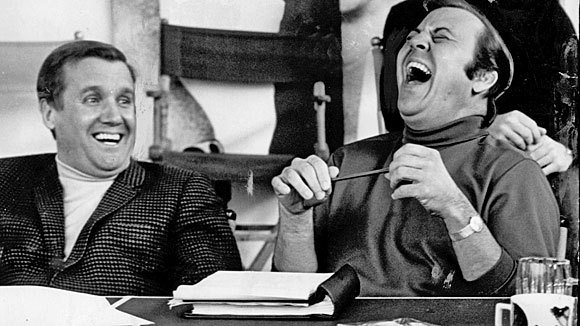
Digby Wolfe and Laugh-In Producer, George Schlatter.Photo c/- LA Times.

Artwiculate: Revenge of the Nerds over the Turds.

I tweeted my first artwiculate entry in August/September 2011. I think I found out I could vote around Xmas time. I learnt to index in March. As you can see I’m not an artwiculate techno nerd. I often don’t vote, and when I do, I vote blind.  During this comparatively short time I have made friends all over the world. Some I have met. Others I hope to. Artwiculate has given me the greatest pleasure, and it is with a deep sadness that I view from afar the ructions which threaten the very existence of the game itself.

Let me say at the outset, artwiculate is not perfect. Perhaps that is one reason why it has recently been so easily manipulated and hacked by people who have no moral or ethical compass. The voting system does need to be revisited. I have also long believed the faulty definitions are deliberate, giving us all some extra fuel to add to our entries. These bloopers have afforded me real amusement. Long may they reign.

I have no axe to grind but I think a little dispassionate observation can be made and hopefully some perspective can be gained. I do not like to rush to judgement.

Twitter is an amazing world, but it is a world where many have adopted anonymous personas and not just one but multiple personas. I regularly engage in conversations with cartoon characters, Marilyn Munroe, Mr Magoo, a chicken, a dog, cats, and a marsupial. Their real names are often not included on their twitter front page but I feel I have come to “know” them quite well.

The 140 character construct is fascinating. People’s lives, irrespective of the relative anonymity of the fictional persona many adopt, become a pot pourri of scattered fragments of information about a life that can gradually be put together as you would a jigsaw puzzle. The first and most obvious thing that emerges is the personality of the tweeter. That cannot be hidden.

If you are a bully in real life that personality trait becomes readily apparent in the twitter world, especially as there is this false sense of anonymity, of not being seen or recognized. I’m sure it is the same sort of thing when you see a driver in a car picking his nose. He is in his car therefore he cannot be seen.

Last night two leading lights of artwiculate were revealed to have accounts in alternate names. I would have been shocked if they had not had other personas. I have long believed I must be one of the few tweeters who has only one account and with my real name there for all to see. The inference is, of course, that they used this to further their position within the game. I remain unconvinced that this was so. I understand the sense of confusion, even betrayal, felt by some who did not know or had not guessed.

Well I had a look and when one persona was being used, the other didn’t RT the entry. To be honest I can’t see that there was/is anything materially to be gained with an additional persona. What I can see is that the alternative persona in one player’s instance allows that player to be naughtier and more provocative, something they may be uncomfortable doing in their own name. This I understand.

The bottom line for me is, and will always be, how have I been treated in my interactions with any of the personas concerned. More importantly it is how I have seen them interact with other people. At all times there has been a great generosity of spirit, encouragement, fun and comraderie which I have enjoyed immensely.

I wish I could say the same of mijeroh.

Since December/January with the introduction to the game of account holder mijeroh, there has been a systematic destabilization of the game, a strategy of divide and conquer, setting players against other players, upsetting longstanding friendships through voting manipulation, innuendos via artwiculate entries and generally snide, sometimes bullying and abusive tweets. A number of new accounts have arrived on the scene to further fuel what has become a campaign against the older, original artwiculate players as well as some of the more brilliant wordsmiths who regularly play the game. Stair71 no longer plays being drummed out by these nasty personas. I miss him. Alastair is a genius.

They have described a number of artwiculati as cheats, tweets that are clearly defamatory. The manipulation of voting that occurred in Jan/Feb by mijeroh, on his own admission, placed players such as permabloom and vivchook in dreadfully invidious positions, and was unforgivable. At no time has he apologized to the arwiculate community. Far from it. Totally unrepentent, his intention seems to have been to start a war. The motives to me remain unclear, but it would seem from his actions that his short-term aim is to rid the game of older, more experienced players as well as the genuinely brilliant wordsmiths, a category, I hasten to add, in which I do not include myself.

What is absolutely unacceptable to me, and should be to most of the delightful artwiculate community, is the level of abuse that has been directed at primarily two of the artwiculati as well as any others who have had the temerity to object. No one should have had to put up with the abuse that has come these past 4 months from mijeroh, artwic, aitfin siliasaki, fakeharp. Bullying and intimidation are not be tolerated in any environment whether it is in the work place, the schoolyard, the sporting field or the cyber community.

Let it be made quite clear, I did not let myself be bullied or victimized when I was a teenager, and it isn’t going to happen now I’m a señior citizen.

I will not be bullied. I will not be intimidated. I will not be victimized. I will not stand back and watch others be bullied. I will report any socially unacceptable behaviour to the appropriate authorities. I will continue to play the game. Some days I’ll vote, some days I won’t, just as I do now. I will not be chased away.

I hope permabloom, vivchook, SJHatzi and harrarp, and those I now call friends who may be thinking of leaving the game, will continue to play in whatever guise they like because they are clever and they move me; sometimes to laughter, sometimes to tears, sometimes to argh!

And that, after all, is what it is all about.

INTERNSHIPS: At Last! An examination of a 21st century middle-class version of the old-fashioned problem of slavery.

For those of you who know me and read my twitter stream, you will know that my pet project over the past three years has been the dire problem of internships. It is what I have termed as the new form of slavery, affecting not the poorest in the land, but this time rather the children of the middle-class.

It is a growing tale of outrageous exploitation without any real regulation or supervision. It’s a hidden problem except by those who profit from it, and by parents who are faced with having to support their under-graduate or recently graduated off-spring while they become the 21st century equivalent of a 19th century Dickensian under-age chimney sweep.

Over the last few weeks I’ve been endeavouring to find statistical data on the number of interns working in Australian businesses at any one time. Little or no stats are readily available to indicate the level of participation of this designation.

(I’ve also been attempting to get statistical data on the growth of the casualisation of the workforce, and this too, is proving to be difficult – but that is another story).

Let me say at the outset that the concept of interns and the invaluable experience that they gain within the workforce can be very useful. However, as is increasingly the case, unregulated areas of business practices seem to open the door to unfettered and unmonitored exploitation of a vulnerable group of young people.

So this brief blog piece is not what I had originally been working on but is the first real public salvo in my fight for some level of responsibility in this area. Anecdotal stories must suffice in the short term.  Let me share a couple of stories that have contributed to my outrage.

The first was a slightly older than average student who has an interesting range of life and work experiences. She’s brilliant at research, has great organizational skills, an endearing way with people and writes any form of copy well.  (High praise coming from me).  I don’t readily offer or agree to give references to students, she was one of the rare exceptions. Call her A.

In most tertiary qualifications there is now a core requirement for work placement in that area of learning a student is undertaking. At most universities the duration of these internships will be for the entire semester. TAFE is in a similar position. The duration of their internships however, is far more flexible with the minimum requirement being a couple of weeks. The TAFE student is, however, encouraged to participate in longer internships if they can be arranged.

Make no mistake if a student does not undertake a form of internship or work placement they will not receive their qualification. It is a compulsory core requirement. For universities it has become a way of saving money. By including internships as a core “subject”, the university doesn’t have to pay for face to face teaching, but the internship will still generate income from these student hours for the tertiary institution concerned.

A… a TAFE student at the time, organized a five month internship at a relatively well-known PR company.  A couple of these months were at the end of her qualification thus requiring some level of supervision from any one of her TAFE teachers.

A… had been led to believe that there was a job in the offing at the end of the internship. It took less than a week for A…, along with the numerous other interns ‘on staff’,  to realize that there would be no job offer.  In a company of approximately 25 people, 12-15 were interns. There was even an intern supervising the interns. At the end of the internship the disillusioned but experienced intern would leave and a fresh-faced, hopeful new intern would arrive. This company relied on the unpaid labour of interns to complete their contracted work obligations to their clients.

No company should be relying on interns to turn a profit.

Interns are not paid. There appears to be no requirement to reimburse out of pocket expenses incurred as a result of additional work requests. There are no limitations on hours worked, no contributions to superannuation and the area of work insurance cover is very unclear when the student stops being a student but continues being an intern. The supervision is cursory and inadequate at best, non-existent at worst. This leaves young and usually inexperienced adults in extremely vulnerable positions.  In the most extreme cases, that of sexual harassment, the legal system is their only recourse, and that is one not often followed.

A… stayed at this company because she wanted a good reference at the end of the 5 month stint. She feared that if she didn’t do all that was required from her she would be denied a reference, which was going to be the only thing she would get from this period of ‘employment’.

B… was another case entirely which resulted in TAFE teachers, including the Faculty Head, bringing the internship to a close. In this instance the intern was offered a 6 month internship for an on-line fashion magazine with the prospect of a job at the end of it. With reservations she was permitted to do the internship but there were strict conditions imposed on the employer by TAFE. The hours were to be no longer than 20 per week, the duties she had to perform were restricted to those outlined by TAFE and she had to be permitted time off for assessments etc.

After approximately a month B…’s attendance became problematic, the quality of her assessments fell alarmingly as well as her ability to meet any deadlines.  She was interviewed and allowed to continue.

B… finally confessed to what she was being required to do and the level of abuse she was receiving from her ‘employer’. This came after she had suddenly burst into tears and was unable to stop sobbing when she had made one of her rare appearances in class. In the two and a half months she had ‘worked’ as an intern for this employer she had done 120 plus hours per week in the three weeks leading up to, during and immediately after Fashion Week. She had been asked to do certain work, which was beyond her training and experience at that stage of her course, and with impossible deadlines for even the well-experienced worker.  She had been the recipient of more than 700 emails and text messages that were overly demanding of the tasks she was being required to perform, dismissive of her educational obligations and downright abusive, intimidating and threatening in their language and tone.

B…was just 18 at the time.

Vulnerable, and intimidated to not tell anyone at TAFE anything, B… was threatened by the employer with a bad reference and a refusal to fill in the forms required by TAFE verifying completion of one of the qualification’s core requirements. B… had decided to battle on to the end of term as best she could. TAFE teachers moved in, had a number of interesting communications with the employer, and the institution was advised not to send anyone to her.

A former student, C… has just finished a third internship with one of Australia’s leading newspapers. This has been a wonderful experience for her as job offers along with references and an impressive CV have been the result. One thing she did raise caused my internal alarm bells to ring when we were discussing a few weeks ago her internship in particular, and internships in general.

C… had just been to the CES, she’s at university now studying journalism and receives an independence allowance. In the course of the CES interview she had been asked about work and she replied that she hadn’t worked the previous three weeks because she had been on an internship. To which she was then told that she had to report all internships.

Apparently internships are deemed to be ‘work’ even though interns are not being paid, are not receiving anything in return for their employment be it goods or services, are not part of a bartering or cooperative arrangement where you get goods in return for your labour. There was no reduction to her allowance as she wasn’t getting paid, even so, unpaid internships must be reported to the CES where presumably they are incorporated into the workforce stats. That seems to be the only logical explanation.  I’m still trying to verify this. I’m also trying to find out why CES needs to know about something like internships that do not result in any payment, cash or kind, being made.

Or, does a reference and an additional line to your Curriculum Vitae count as barter: a service in return for unpaid labour? Does this then justify the hours, weeks, months worked by unpaid interns being counted in the employment figures?

It looks like the Australian Government is now going to have an inquiry into internships.  The union movement has, on the whole, abdicated their responsibilities in this area, and I’m not sure who is going to represent the interests of the student-intern. Up against the intern will be the business community, some of whom rely on this form of slave labour to make a profit, and academic institutions.

This is the first installment of what I know will be a continuing story on the new middle-class manifestation of an old working-class problem.

KEVIN? Not on your sweet Nelly

Since the release of the latest opinion poll results I have yet to see any serious or detailed analysis as to why there has been an improvement in Labor’s position. The column inches and on-air time have been devoted to the ‘lifeline to Gillard’ approach when reporting what was an unexpected statistically significant shift in support for both the Prime Minister and the Labor Government over the Christmas break.

There would certainly have been two groups who must have been bitterly disappointed at the results. The first being the media who are enjoying the feeding frenzy that a possible leadership spill provides. The second is Kevin Rudd because I suspect his timetable has been somewhat disrupted. Actually Abbott may have broken out in a little sweat but at this stage it will be nothing of significance.

Julia Gillard is one tough operator. She may yet survive the relentless political pressure she is under. If these poll figures continue to improve there is every likelihood this could happen. Everything is on such a political knife edge for the Government: the independents’ support in the House, the nervousness in the caucus, the perceptions of the public, the global economic situation and, of course, the media.  Despite this precarious backdrop the Government has a legislative agenda that would be considered daunting if governing in its own right rather than as a minority government teetering on the brink.

There is the assumption that if a leadership change was to occur in the Government that it would be inevitable that Kevin Rudd would be the automatic goto guy. The mainstream media certainly expects it. Yet it would be foolish of them to make this assumption. The ‘anyone but Rudd’ faction has the numbers, and, apart from his core group of supporters,  the majority of members are not prepared to revisit a Rudd leadership. Labor has been down this path. Members know where it leads and the likely experience the return journey would give.

Kevin Rudd reminds me of a duplicitous Cheshire Cat. He is there one minute, and when the going gets tough for the Government, poof; he disappears except for a large smile lingering awhile to remind us all that he is still there, but really not.

Of course it goes without saying that the position of the independents must also be taken into account. The Greens would work with Rudd; they’ll work with anybody. The independents, however, may be different kettle of fish, and remember it only takes one of them to upset the apple cart. The key is Windsor, a man of integrity and humour, and for whom I have considerable time and respect.

Gillard is now in the position that everything, and I mean everything, must work in her favour resulting in improved polling numbers.

The Gillard/Rudd speculation has blocked any focus being placed on the underlying leadership tensions that exist within the Coalition. Apparently the media can only look at one leadership issue at a time given its seeming inability to walk, talk and chew gum simultaneously. Make no mistake, concern about Abbott’s style of leadership is there simmering away, but currently under the radar.

While the Coalition continues to have a comfortable election-winning lead Abbott will remain as Leader despite his appalling personal numbers. If the gap between the two major parties continues to narrow attention will turn to his position. There are many within the conservative side of politics who are uncomfortable with the tea party style  approach to both policy and strategy that Abbott has adopted.

The key spotlight that is thrown on anyone who occupies the position of Prime Minister is much brighter and more critical than the lights that shine on other key members of parliament, including the Leader of the Opposition. Choosing a leader is a kissing frogs exercise. A candidate, who you would wager would be a great leader, can fall at the first hurdle especially during times of criss. Menzies is a good example. He was hopeless as a leader in war time, and went on to prove that it’s easier appearing great when times are great. Curtin, the quiet, unassuming, door-mouse like character was the most unexpectedly successful leader for this country at a time of dire need.

Rudd is a known quantity found wanting under this critical spot light of leadership. The Labor Party can’t drink at this well again. The water was found to be too brackish.

POSTSCRIPT 15th February 2012

The political situation facing the Labor Government is becoming increasingly intolerable. Irrespective of the rights or wrongs of the current situation and the double standards of the overall media coverage,  the political reality is that the Prime Minister cannot continue in this role. The analysis can come later. Labor needs to look at a successor.

I’ve been asked, given the last two blog posts, what my view is. Here is my view for what it is worth.

Rudd is not to be considered. There is a large cross-factional faction who, having previously experienced his leadership style, will not return for another visit.

What is left is the three S solution: Swan, Smith and Shorten.

I will deal with each briefly. Bill Shorten, Member for Maribyrnong since 2007, is well known, competent but has yet to get the miles into his legs. He hasn’t sufficient experience. He will be a future Labor leader, but not this year.

My  friend, Bob Ellis, included Anthony Albanese in the equation. I wish. He has been the most effective performer on the floor of the House this past year, however, he has to be dismissed from any real consideration. Why? One word: Faction. Two words: wrong faction. I would be ecstatic if proved wrong.

This leaves Stephen Smith, the Member for Perth and Wayne Swan, Member for Lilley, both elected to Federal Parliament in 1993. Wayne Swan has been a brilliant Treasurer. He has grown into this job now occupying it with a calm, assured and authoritative aura that he brings to the public debate. If circumstances were normal I’d be happy for him to take over the leadership, but they are not. Europe and US economies are still balancing on a knife edge. Swan needs to remain where he is, on top of the fiscal and economic plot. It is essential there is a strong and competent Treasurer guiding the debate over the next few years. Another certainty is that neither he , nor anyone-else, can do both jobs. The Prime Ministerial position will require full attention

My preference, therefore, is Stephen Smith, another highly competent front-bench performer. He has done more than has been asked of him. Like Swan, Smith too, has a similar steely quiet, knowledgeable and authoritative air. It would not be the first time that Australia has had a Prime Minister from Western Australia at a difficult time. I’d have both men in the top two jobs. From a psephological perspective, and somewhat serendipitously, it can only help Labor that Smith’s from Western  Australia and Swan’s from Queensland .