Julia Gillard: For whom the bell tolls…

I hate to see the death of talent. In these past months we have been forced to watch the apparent death throes of two highly intelligent and very competent women, both in the top echelons of their professions.

For any woman who works in a profession, and I don’t care what profession it may be, there is an adage: “You have to be twice as good before you can be considered equal.” I first heard this saying in the early 70s when I worked in a predominantly male domain. Unfortunately it applies as much today as it did 40 years ago.

Photo by Mystify me Concert Photo (Troy)

Julia Gillard

The likely demise of Julia Gillard as Prime Minister raises certain questions involving the role of the broad stream media, the current world wide political dynamic that is irreconcilably divisive, and the deep seated misogyny that shows itself to be still a fundamental part of Australian society.

Since Gillard’s ascension to the main job it has been interesting as well as dispiriting to see how she has been treated by those institutions in Australian society that come with influence and power. The lack of respect or deference to the office of Prime Minister has been evident. In many ways Gillard’s treatment has run in parallel with the treatment of President Obama by similar American institutions.

Australia has a woman in the top job, in USA a black man is President. Both leaders have had to endure a level of vitriol, unsubstantiated criticism and out and out lies, all fueled by misogyny on the one hand, and racism on the other.

If you look at the record of both, major changes have been achieved against all odds in a deeply polarized political environment as well as in the face of a cataclysmic international economic climate that has yet to reach its conclusion. These changes are fundamental with far-reaching benefits for a larger part of the community who were previously disenfranchised.

Gillard’s legislative achievements as a minority government will be forever on the history books as being truly remarkable given the context and constraints within which she had to work.

Why the demise ?

Gillard needed the support of the right wing faction to overcome Rudd and move into the Lodge.  The reasons behind this are well known. A seriously dysfunctional Government led by a person who likes to micromanage and getting so inundated with decision making unable to make decisions. This conundrum is not unusual for those who like to control all.

The problem about those not from the right receiving support from the right is the right wing’s belief that they own you and have an inherent right to manage you. (Oh and haven’t they been doing such a bloody terrific job of it this past decade, especially in NSW.)  Certain compromises must be made. That is a political fact.  But problems arise when those compromises so obviously fly in the face of fundamental and well-known beliefs and values

Gillard was prepared to compromise what the rest of the population perceived as a core value for her. Why? -To keep the likes of Joe de Brun happy campers. In a man the public will forgive flip floppery, sexual peccadillos and the like.  Not so a woman.  A woman in politics must preserve that which she holds important as something almost sacrosanct –  ‘To thine own self be true’ stuff. – A double standard? – You betcha!  But it is one that exists so ignore it sisters at your peril. Thank you Julia, lesson learnt. Tell de Brun and his ilk the answer is no, because if you are a woman and it is important to be seen to be driven by conscience, not political expediency. A double standard? – You betcha! Howard and Abbott flip flopped on supposed core values. Not a squeak was heard, in the case of Howard, nor is with Abbott , from the mainstream media. After all, the mainstream media now has an agenda and it reaches in to the political arena. The media outlet is just one little branch of a larger conglomerate, and often is not even profitable but in terms of clout, immeasurable.

You are ultimately as good as those who are your advisers, and Gillard’s office from the get go, has been questionable in their policy advice, strategic planning and communication skills.  At every critical stage they have apparently suggested pulling the wrong lever. In the end Gillard has to accept the responsibility for not organizing a better advisory and support group. Her team has not done her any favours.

Those who have set out to demonise her, and they include the more conservative elements in Australian business, religious and political circles, have lost all sense of proportion, appropriateness, and especially in the name-calling, decency.

In this regard the mainstream media is also culpable. As part of the commercially driven businesses now owning them, media outlets perform as players rather than as dispassionate and analytical observers. It is as if, from the beginning as Prime Minister, Julia Gillard’s being a woman, however competent, made her more open to a level of abuse that would not be accepted if a Howard, a Keating, or even a Rudd, were occupying the Lodge.

To those younger women who now occupy reasonable positions within the professional workforce, make no mistake. The struggle to overcome the entrenched and deep-seated misogyny that is a blight on this country is far from over. I had hoped, but fear I will not live, to see its demise

We are seeing the same scenario playing out in parallel in the USA where in this instance the malaise that stops them from progressing as a civilized society is racism. It is so easy for those who are happy to live with a personal toxic level of political opportunism and cynicism, to use fear as a political engine driver, manipulating large numbers of the public by appealing to their most basic concerns. Racism, sexism, and religious bigotry are the result. This takes generations of more reasonable policy to overcome and restore the veneer that civilizes us as a society.

The final shock for me has been the performance of Michelle Grattan. Grattan has been a journalist who, in my mind, has been an exemplary journalist of impeccable integrity and, for the last near 40 years, one of the few journalists whose work I relied upon. Her work when discussing the Prime Minister this past year has lacked the usual clear, dispassionate, analytical thinking, and instead, it has been coated with a certain level of venom. Grattan’s reputation and gravitas earned over the last four decades and which she always brought to any topic have now been pissed up against the wall. The reasons why she would undermine her reputation in such a way appear unclear, well at least to me at any rate.  Her work smacks of a personal dislike or appears driven by some personal history. Journalists, like the rest of us, have personal baggage that’s accumulated through life’s journeys. The really good journalist is able to recognize the baggage and compartmentalize it so that it doesn’t taint the work done. Why Grattan appears not to have been able to do this when covering stories about the Prime Minister is unknown and is a great shame.  For those who wish to read her last missive, the one that has prompted this piece as I found it nothing short of a disgrace from a journalist of such standing, I have included the following link.

Please read and judge for yourselves.


auspol.info/w8jmJA 2.webloc


YUK BALLS: a cri de coeur. The Brussels Sprout: a cry for help.

May 9th, 2011

I have never met a brussels sprout I liked.

I know brussels sprouts are supposed to be good for you being chocka block full of anti-oxidants, minerals, vitamins and having no negative impact in terms of fats and cholesterol. They just taste ‘erky-perky’!

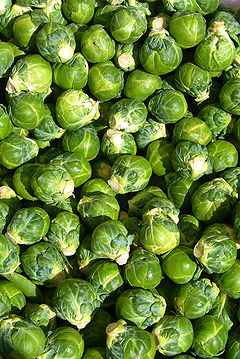
Brussels sprouts have been forever known in our household as yuk balls.  As children, my sister and I would howl the place down when confronted with a bowl of brussels sprouts as being the green vegetable to be consumed as part of the evening meal.  Please note that I use the word confronted rather than presented.Photo taken by Eric Hunt. 24/10/2006

I describe the vegetable as green advisedly, as it was so overcooked that the only way Bet, my mother,  could keep said vegetable green was with the liberal application of bicarbonate of soda.

Bet was a powerhouse. She was a dynamic, unique, engaging, uncompromising woman of integrity who encouraged my sister and I to believe that we could be anything that we wanted to be at a time when that was decidedly unfashionable. Cooking, however, was not her long suit.

So I have spent all my adult life avoiding yuk balls.  These miniature cabbage balls of bitterness sit in the F & V section of my supermarket daring me to play with them. For four decades I have avoided taking on the challenge.

Feb 1st, 2012

My intention behind writing this piece was to find and collect recipes that make the seemingly inedible edible

I wrote this before I started to tweet. Since then I’ve developed a friendship with a number of the artwiculati who are also foodies. A discussion arose about brussels sprouts, and it quickly divided into those who, like me, gag at the mere thought of yuk balls for dinner, and those who love them. Recipes and methods of cooking sprouts were offered up as examples. Here they are. Feel free to add to the list and discussion.

VIVIENNE’S RECIPE for ROASTING BRUSSELS SPROUTS in GARLIC

@vivchook

Vivienne is a very talented and much loved member of the artwiculati. She seems to have endless time and patience with those of us who still don’t know what the hell we’re doing. To be “mwahed” by @vivchook brings a smile to the dial. Here are her suggestions.

  • Cross cut the bases of the Brussels sprouts
  • Fill with a sliver of garlic
  • Roll in Olive Oil
  • Roast for 40 mins @ 190C (I’m assuming this is a conventional oven, minus 10C if fan forced).
  • The outer sprout will be crispy and nutty, the inner nutty and garlicy
  • Season to taste.

Vivienne also suggested cutting  a cross in the base of the sprout, inserting the sliver of garlic and then standing the base of the sprout in a pool of balsamic vinegar for an hour or two.

SILIA’S SUGGESTION: BRUSSELS SPROUTS topped with SHAVED PARMIGIANO

@SJHatzi

Silia is the numero uno of artwiculati players. She is seriously brilliant in her command and manipulation of  language. She plays with words like a sculptor would play with plastercine. She tempers her brilliance with being one of the nicest people with whom you can chat about anything. Like Ms Chook, Silia makes you feel welcome.

Silia suggests roasting the sprouts in the oven and topping them with shaved Parmigiano.

She also gave me a link to simplyrecipes.com. It is as follows:

simplyrecipes.com/recipe#5D1EF6

Good Luck

Enjoy


MY KEDGEREE

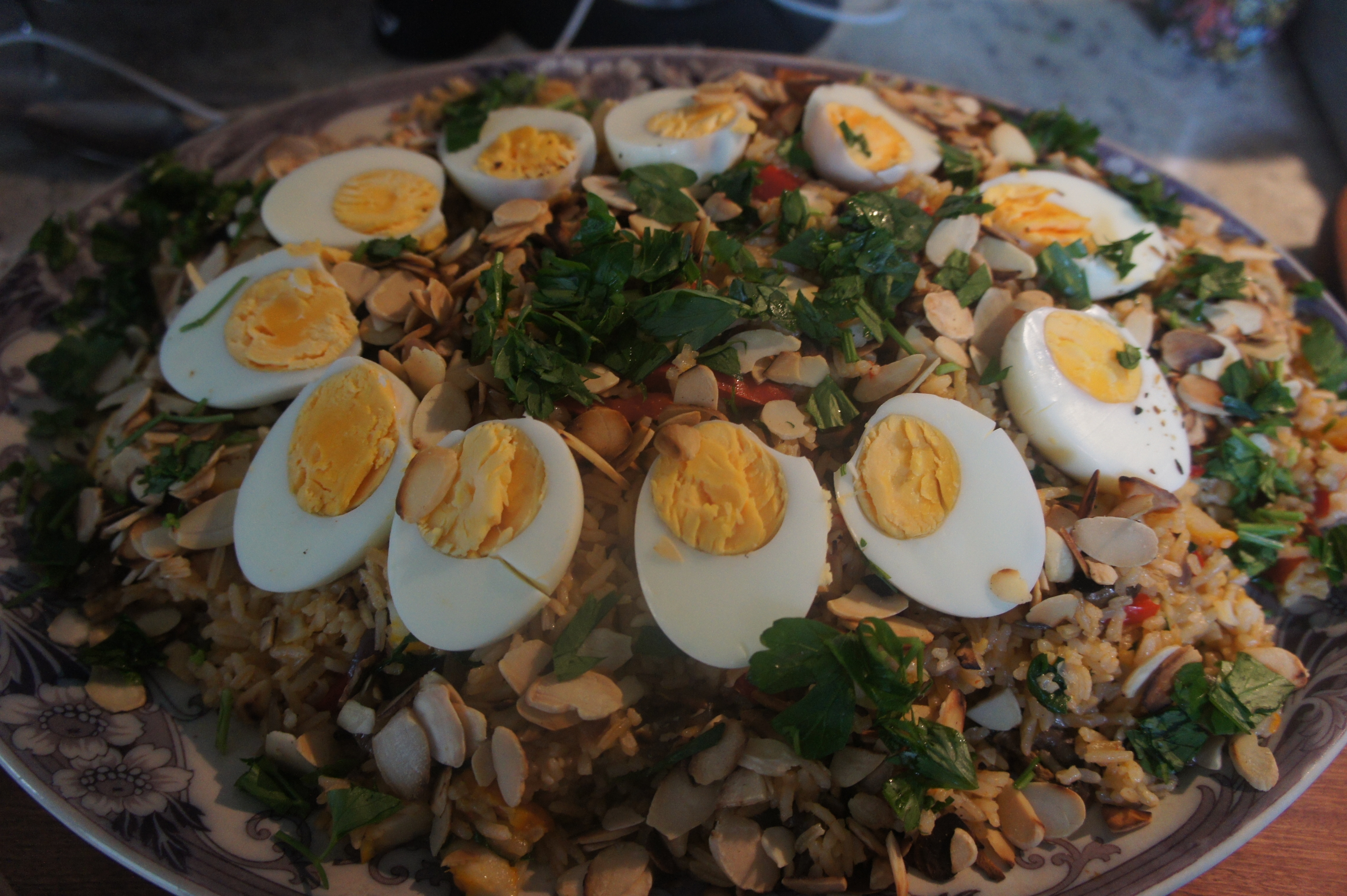
This is one of the great comfort foods. We have it at anytime of the year irrespective of the season. I first cooked kedgeree about 30 years ago. Since then I have played around with the recipe until I created the one that was not only easy to cook, but was the one I liked most. Kedgeree has now been established as a tradition for Boxing Day brunch. My children insist. It is also great party fare. I always cook it when I’m entertaining and have spare copies of the recipe to give to guests who request it.

Photo by the author

My Kedgeree

The first time I ate kedgeree was in 1980 when His Nibs and I were doing the ‘grand European tour’ for the first time. We stayed at a disgracefully expensive converted old manor house in St Albans complete with its own lake, ponds, amazing gardens along with an assortment of ducks, peacocks and swans that loudly proclaimed their ownership of the grounds. As part of the breakfast menu was kedgeree, a dish I had never even heard of before much less tasted. One mouthful began a lifelong romance with this eccentric dish.

I came home and began to try to reproduce the dish from memory, experimenting with different ingredients and alternative cooking methods until I was satisfied with the end result. There were no recipes for kedgeree in any of the Australian  cook books of the time.

To describe kedgeree is difficult. It needs to be tasted but here goes nothing. Kedgeree is curried rice with vegetable and smoked fish, finished with chopped coriander, boiled eggs and toasted nuts. It sounds disgusting but is a taste sensation. Kedgeree was created in India during the time of the Raj for the Scottish regiments posted there who were missing their salted fish dishes for breakfast. Although its origins are in India it is considered a Scottish dish, but it is really a heady mixture of two totally opposing food cultures coming together in one scrumptious multicultural match made in heaven.

Kedgeree is usually cooked on top of the stove, as you are supposed to do with risotto, but I don’t. I cook this dish in the oven. Truth be told I also cook risotto in the oven much to the horror of purists and food fascists, but that is another story.

RECIPE

INGREDIENTS:

  •  500-600 grams of smoked cod
  • 1&1/2 cups Basmati Rice
  • 1 Red Onion
  • 1 red Capsicum
  • 1 yellow or orange Capsicum
  • 1 heaped teaspoon of minced garlic
  • 1 dessertspoon of curry paste (I prefer red curry)
  • 1 teaspoon cumin
  • 100 grams peas or beans (I prefer peas)
  • 2-3 cups Stock
  • 75 grams butter
  • Parsley chopped
  • Coriander chopped
  • 6 eggs boiled and halved
  • 100 grams almond flakes toasted

INSTRUCTIONS

  • Place the smoked cod in a dish and cover with milk. Allow the fish to sit in the milk for a couple of hours to allow the salt and colouring to leach from the fish.
  • Dice the onion and mince the garlic. Chop the capsicums into bite size pieces.
  • Melt 50 grams of butter, throw in the onions, garlic and capsicum and saute until they begin to soften. Stir on the curry paste and cumin and stir it all around.
  • Add the remaining butter and stir in the rice until the rice is nicely coated with butter and spice.
  • Add stock and seasoning. Bring it all to the boil and bubble away for a couple of minutes.
  • Put the dish into a preheated oven, 170C for fan-forced, 180C for conventional ovens.
  • It will be about 20 minutes for Basmati Rice, 30 minutes for brown rice.
  • While the rice is cooking in the oven take the cod out of the milk and pat dry and then shove it into the microwave for a minute or so. Flake the hot fish into bite sized bits making sure you get any bones. Cook the peas in the microwave for a minute or so. 5 to 10 minutes from the end of the rice’s cooking time add both fish and peas to the rice in the oven and stir it through.
  • Toast the almond flakes
  • Halve the hard boiled eggs
  • Chop the parsley and coriander
  • Spoon out onto a warmed platter. Arrange the egg halves on top of the dish with a sprinkling of almond flakes on top, followed by chopped parsley.
NOTES:
  • We have one member of the family who hates coriander so I put coriander in its own little dish for those who want it.
  • For those who like creamy curries there is also the option of adding cream (or yoghurt) to the dish, something I tend not to do. But 2 dessert spoons of thickened cream or 2 dessert spoons of yoghurt will add a creaminess to the dish without being too cloying.

ENJOY!

THE FLOWERING CHRISTMAS BUSH THAT WOULDN’T

Photo by author

The Australian Flowering Christmas Bush that wouldn't

It stands at the front gate of our holiday house in Jervis Bay in all of its 30’ majesty exuding the health of the well-fed and well-watered, a welcoming beacon to all comers. The Flowering Australian Christmas Bush is one of the few original trees (or more accurately, shrubs) planted when His Nibs and I first built here over 26 years ago

The Flowering Christmas Bush, like the Flowering Gum, was always going to be on our ‘to plant’ list when we came to design (using the word loosely) our garden.  These trees were an ever present part of my childhood along with mondo grass, parsley growing everywhere like weeds, agapanthus, clivias and gardenias. The christmas table was always decorated with the red flowers of the Christmas Bush punctuated with the purple of the agapanthus, and the scent of the gardenias transcending all.

Irony in nature doesn’t immediately spring to mind when considering plants. Mother Nature’s sense of humour is a given when considering the birds, bees, fish and beasts. Anyone can suggest a giraffe, a dugong, the dodo or peacock and a wry smile emerges at their weird evolutionary bizarredness. But plants – no, nothing readily comes to mind. This is probably more an indictment of my pathetic lack of knowledge of the plant world. What little Australian flora and fauna I recognise comes more from May Gibbs than any gardening tome

So over the last 26 years, towards the end of each year, I have carefully scanned our Flowering Christmas Bush to see if there was any evidence of a floral tribute. No, nothing, always nothing.  The tree has always been, and still remains, disgustingly healthy, but no flowers have been forthcoming.  For 20 years there have been many discussions about what to do, google has been unsuccessfully searched, any and all bush remedies considered.

The most drastic remedy was forcefully suggested each year by my mother. (God I miss Bet). A 5’2” pocket dynamo whose sweetness of demeanour and ready humour belied the gypsy warrior woman she was.  “Burn the bloody thing” was her solution; “Set fire to the base of the tree and let it rip” was her instruction. Each year with the absence of flowers, and my tearing my hair out at this botanical recalcitrance, Bet would emerge with a box of matches ready to do the dreaded deed. The fact that we live on the Jervis Bay National Park bush line, and to light a fire at anytime of the year even in a snow storm (which historically we have never had except during the last ice age) would result in legal consequences too dire to contemplate, was dismissed by her as a mere bagatelle. We’d hose Bet down, and no match, lit or unlit, was permitted within the immediate vicinity of ‘the tree’.

Photo by author

One of next door's Flowering Christmas Bush towards the end of the flowering season.

We’ve cut said tree back at those ‘special’ times of the year, and when the moon was full, when waxing, when waning, when the moon was doing both simultaneously, during a planetary lineup, the passage of Haley’s comet, all to no avail.  Special concoctions were prepared to ‘feed’ the tree. One year an entire packet of Epsom Salts was watered into its root system resulting in more luscious looking leaves, but still no flowers.

The Christmas after Bet died, some seven flowering seasons ago, the tree gave forth eight individual flowers. Those of you who are acquainted with Flowering Christmas Bush will know just how teeny weeny the individual flower is.  The splendour of the Christmas Bush is the clumping together of individual flowers resulting in huge and splendid ruby red splashes of colour that grace so many Australian gardens. I came in so excited to inform all and sundry I had eight individual flowers on the Christmas Bush. His Nibs wanted to know their names. Bastard! Since that memorable year it’s been a floral wasteland.

I gave up. For years now we’ve done nothing at all to the tree content to let it grow, and prune it when it became too big.  Friends asked us if it really was a Flowering Christmas Bush (it is) and why didn’t we cut it down. The tree has become a haven for the little birds: the sparrows, finches and Mr & Mrs Wagtail, old friends for whom we’re happy to provide a home.

It was with profound shock, when we arrived at Jervis Bay this year, to find that our sentinel had flowers, a crop of them.  One small branch had flowered. Why? We have absolutely no idea. This floral blemish on an otherwise beautifully green leafed tree even occasioned comment from our neighbours who, to add insult to injury, have three magnificent examples of fully functioning Flowering Christmas Bushes, all in that glorious dark red colour. Over the years they’ve watched with much amusement at our various attempts to get the tree to flower, and commiserated with us when it didn’t.

Photo by author

A rainbow lorikeet nibbling on the few flowers I have on my Christmas Bush

Of course nothing is ever easy. The branch with the flowers attached is too high to pick as decoration so, of course, I’m left with no option other than to purchase my Flowering Christmas Bush flowers at outrageous cost from happy florists. If ever there is an example of the definitive botanical raspberry this tree is responsible for it. Bastard of a tree! Will we ever cut it down? Never! It has become another eccentric member of our extended family – a tree with personality and attitude.

Ain’t nature grand!?

On Twitter – a lesson in good manners.

Peter Phelps, MLC versus tweeps.

Twitter is the cyber equivalent of Speakers’ Corner. In the old Speakers’ Corner you could get out your soap box and say whatever you like, especially venting on those issues of the day that had given you the shits. The really great speakers could always attract a crowd. Their subject of special interest was laced with lashings of good humour, a lot of it self-deprecating, and witty repartee with those members of the general public who decided to stop, listen and engage. Even the most heated debates rarely descended into personally abusing an opponent when the rigours of the debate became too much.  There always seemed to be an unspoken understanding as well as a certain degree of tolerance and good humour that permeated the scene.

In today’s world such niceties of behaviour have long gone. Today’s plethora of shock jocks whose appalling lack of manners are tolerated because of the ratings and money that such behaviour generates, and reality television that belittles and regularly abuses those who appear, are the backdrop to a form of populist culture that certainly dominates in terms of quantity.

It is, therefore, interesting and quite unexpected to discover that when you enter the twitter world things can be a little different. In the five months I’ve been tweeting I have come to regularly converse with a very nice, intelligent and engaging group of people, a reflection of my eclectic range of interests. In that time there have only been three instances of what I would describe as unacceptable antisocial behaviour.  All three cases involved men of some authority and status who, when confronted with either reasonable questions to which one expected reasonable answers, or exceptions to what they had said, or, heaven forbid, alternative points of view, resorted to a form of personal abuse that was both unnecessary and highly offensive. In all instances these personal attacks were against women.

In two of these cases both men should have known better, but that didn’t stop them from behaving like bully boys as well as being just out and out rude.  My! How proud their mothers must be. One is a recently arrived journalist for a prestigious overseas media outlet. The other is a politician who yesterday came unstuck when his imprudent language and behaviour, which I suspect to be commonplace, was deemed to be beyond the pale by a number of twitterers.

The details of what Mr Phelps said that prompted the outrage was a tweet about a fellow committee member, Rhonda V, and female witnesses to parliamentary committee hearings and their need to ‘HTFU’ (harden the fuck up). This tweet resulted in a number of tweets. One of which came from @Nyx2701 suggesting that perhaps Mr Phelps needed a “good punch in the head.” To which Phelps wrote the now infamous tweet of telling Ms 2701 to “go fuck yourself, commie! And you can’t complain because I put in a smiley;-)”. Well I don’t know whether Ms 2701 wanted to complain or not, but there were a hell of a lot of us who sure did.  My contributions were small potatoes compared to others, however I did suggest that if Mr Phelps couldn’t behave himself with more decorum then perhaps he shouldn’t tweet; that he was in a position in which his behaviour is expected to be of a certain standard; and descending into personal abuse indicated a lack of intellectual application on his part. These contributions were met with a few offensive, demeaning and just rude replies, but was nothing more or less than anyone-else received from Mr Phelps yesterday, except of course @Nyx2701 who received the brunt of Mr Phelp’s toxicity.

www.smh.com.au/ 2.webloc

Ultimately the he said, she said, we all said does nothing more than indicate that Mr Phelps feels he can get away with this kind of behaviour on twitter because he seems to be able to get away with it in the non twitter world. I suspect he was quite taken aback when a number of tweeps took umbrage at what he had said, and were forthcoming in their disapproval.

Twitter gives one a false sense of security. Often you are conversing with total strangers, sometimes in a country not your own. It is therefore easy, if your personality tends towards the bullying, to think that it isn’t going to matter a jot if you engage in similar kinds of behaviour on twitter as you exhibit in all other areas of your life. One would expect it to be even easier because of the anonymity that appears to be Twitter. I now believe the reverse to be true.

At anyone time there is a whole group of people on Twitter who will happily stand up and attempt to nip cyber bullying in the bud, deeming it to be totally unacceptable.  The anonymity of the cyber environment can instead liberate the intended victim to a position of not giving two hoots as to who you are, what position you may hold, or what profession you may have. The subject of the abuse can’t be physically intimidated, and, if someone has to resort to bullying or personal abuse, their intellectual vigour has been found wanting.

Twitter is empowering, informative, can be intellectually stimulating as well as creative and just out and out fun. No one should have to put up with the nonsensical, offensive and mean spirited abuse that came from Peter Phelps yesterday.  He is a publicly paid for politician who is supposed to be a part of a group of individuals, including church and corporate leaders, that together are supposed to help set the moral tone and standards we, as ordinary Joes, are then supposed to emulate.

Codes of conduct and ethics don’t grow from the ground up, they filter down from the role models at the top of the societal tree. If the current younger generation is not living up to the standards we would like, then we should start looking at the examples set by our leaders.

Barry O’Farrell was disappointing yesterday.  It was very nice of him to apologise, well he didn’t really apologise actually. Rather, it should not have been O’Farrell’s role to be put in the position of having to “apologise” on behalf of Mr Phelps. Mr Phelps should have apologised to those he sprayed, and not stood behind his leader as a small child stands behind its mother when in trouble. From Phelps there is still nothing but a deafening silence. The absence of an apology from Mr Phelps says volumes about the manner of the man.

To those who were sufficiently outraged to speak out yesterday I salute you. @Nyx2701 who was the subject of the most offensive rant, @greenat15, @kateausburn,  @mrtiedt, @kimworldwide  and @Jo_Tovey  @SMH

To poor Rhonda V who has to sit on a committee with Mr Phelps you have my most heartfelt sympathy.

THE NINE PARTS OF SPEECH for those who want to parse.

This has been written in response to a request for some information on the parts of speech. As a number of my students who, at the tertiary level of study, are just starting out on their journey of discovery of the language that is their birthright, I’m making this simple.


A POEM 

on 

THE PARTS OF SPEECH

Three little words we often see,

Determiners, like a, an and the.

A Noun’s the name of anything,

A school or garden, hoop or string.

An Adjective tells the kind of noun,

Like great, small, pretty, white or brown.

Instead of nouns the Pronouns stand –

His head, her face, my arm, your hand.

Verbs tells of something being done,

To read, write, count, sing, jump or run.

How things are done the Adverbs tell,

Like slowly, quickly, ill or well.

A Preposition stands before

a noun, as in a room, or through the door.

Conjunctions join the nouns together,

Like boy or girl, wind and weather.

The Interjection shows surprise,

Like Oh! How charming! Ah! How wise!

The whole are called “Nine Parts of Speech”,

Which reading, writing and speaking teach.

This poem is the equivalent to a 19thC teaching aid by that well-known author, Anonymous.

Is this useful? Yes and No. When parsing a sentence it’s very useful, and there, I suspect, it ends. Why? Because the function a word performs in the sentence will determine the rules that must then be applied.

What looks like a verb, sounds like a verb, even smells like a verb can be functioning within a sentence as a noun. For example, ‘swimming is good exercise’. Swimming, a verb, a participle in fact, is functioning in this sentence as a noun. (Such things are called gerunds). Or, what about ‘I had a swimming lesson today’. Swimming is now functioning as an adjective.

With the differing function, mood, or whatever, the rules can change, and you need to know the rules before you go ahead and shatter them to smithereens. This is the ultimate goal; to know the rules so they can be broken without muddying the communication waters.

In the English language if it walks like a duck, quacks like a duck, smells a l’orange – it just might turn out to be a goose!

For the record, determiners are now known as articles. ‘A’ and ‘an’ are indefinite articles, and ‘the’ is a definite article.

The ‘interjection’ is deemed to have no grammatical function what so ever! What they do, however, is important to the creative process.  For example;

            ‘Oh! Look at that.’

            ‘Wow! Look at that.’

            ‘Shit! Look at that.’

            ‘Oh Fuck! Look at that.’

The interjections that start each of these sentences give a clear idea of the emotional state of the speaker. From a grammatical perspective they may have no function, from the creative, you can’t live without them.

There are some books that I think are essential on a library shelf.  For some reason that is known only to the powers that be, I can’t bring myself to throw away my copy of Fowler’s English Usage even though it is over 40 years old; was useless as tits on a bull when I had it as a university textbook 40 years ago, and is written in language best described as inaccessible.

The book I use all the time is a 2003 edition of COLLINS GOOD WRITING GUIDE by Graham King. I insist this book is the textbook for my students. I have kept the estate of the late Mr King ticking over in royalties. They may have changed the name of the book but I know it’s still available. Graham King is the clue. He fell off the perch over a decade ago. It’s a shame. I would have liked the opportunity to thank him for such an excellent resource, which is also a sheer delight to read. Harper Collins are the publishers.

My next post will be on participles, and I haven’t forgotten your request Katie about the ins and outs, and I’m afraid at the moment it’s out, of the Oxford comma.

BROWN RICE SALAD FOR THOSE WHO HATE RICE SALADS WITH A PASSION UNEQUALLED IN THIS WORLD.

I hate rice salads. His Nibs loves rice salads.

I hate brown rice in particular. His Nibs loves rice, especially brown rice.

His Nibs hates pumpkin, capsicum and rocket lettuce. I, of course, love all three.

We’ve been together forty years – it’s a miracle really!

For the past decade or so I have experimented with every conceivable kind of rice salad recipe. This is a mish mash of so many different recipe combinations I’ve lost track.

This recipe works for us. It is a modern miracle approaching biblical significance.

You can eat it cold, room temperature or heated. It is one of the best comfort foods. Like ‘THE SALAD FOR THOSE WHO HATE SALADS’, this RICE SALAD flies off the plate when we entertain.

Friends have requested this recipe for some months now. I apologise for the delay. The weather now lends itself for this dish, although I eat it heated up during winter as a comfort food.

RECIPE

INGREDIENTS:

  • 1 cup of brown rice
  • 1 red capsicum
  • 1 yellow capsicum
  • ½ pumpkin, preferably Qld blue
  • 1 Spanish onion
  • 60gm of pine nuts (almond slivers/flakes option)
  • Rocket  lettuce or Baby spinach
  • dried basil (I know I’ll explain later)
  • olive oil.

The Brown Rice Salad

  1. Chop your capsicums and pumpkin into small bight size pieces.
  2. Roughly chop you onion.
  3. Put them into a baking dish with olive oil. Swish them around to make sure the vegetables are well coated with oil, and then sprinkle them with a healthy large pinch of dried basil. (Dried basil works better in this dish, for some mysterious reason, than the herbs I grow. They’re stronger and more aromatic). Season with pepper and salt.
  4. Put them in the oven at whatever is the right temperature for your type of oven. Mine is fan forced so it’s 170C. Do them to your personal preference. I like my capsicums well roasted; my pumpkin I pull out early because I want it to disintegrate and become so mushy it coats the rice. I bake the pumpkin because it tastes better when baked rather than boiled or steamed, and I want that sweet roast pumpkin flavour.
  5. Dry roast your nuts.
  6. Boil the crap out of the brown rice. Follow the instructions on the pack. If you do the fast boil method, then it’ll take 20-25 minutes.
  7. Take a healthy handful of rocket .
  8. Combine all ingredients in a bowl. The rocket will wilt, which is what it is supposed to do, so don’t panic.  Stir ingredients through.
  9. You don’t need any dressing as the oil and the pumpkin coat the rice. MAGIC!

 A MUST.

You must taste test the dish at this stage to make sure it is as you want it to be. Be warned, however, your other half may deem this his right, and there will be a struggle over the taste testing step in the process.

ENJOY!

EATING MY WAY AROUND AMERICA (Part 1) or How I gained 5kgs without really trying.

MY FAVOURITE RESTAURANT: THE ENGLISH GRILL

The English Grill, Restaurant at the Brown Hotel

Photo supplied b y the Brown Hotel

From the moment I stepped off the plane in Louisville, KENTUCKY, I started to sneeze uncontrollably. Sneezes turned into the most appalling sinus/hay fever attack that lasted the 5 day duration of our stay. Sinus headaches, more sneezing, tickly throat, aches and pains, watery eyes – you name it. I got it. I felt wretched.

His Nibs, who is a shocking sufferer of hay fever, didn’t get so much as a sympathetic sniffle.  I used everything in the portable pharmacy he carries around with him when travelling overseas. Nothing worked. He suggested that I was allergic to a red state. My sister concurred, and suggested that this was why states such as Kentucky were flyover states.

The only time I had any relief from this awful wretchedness was when we went to Churchill Downs Race Course (where they run the Kentucky Derby) to see the last group 1 of their racing season, and when visiting the various horse studs that dot this neck of the woods. I never knew that horses and horseshit were a cure for hay fever. It is so unlikely, therefore, that the winner for my favourite restaurant in the USA dwells in the centre of Louisville, KENTUCKY, and that it goes by the unexpected name of The ENGLISH GRILL. This restaurant is responsible for my eating, over two nights, perhaps one of the best meals I’ve ever eaten. Ever! Anywhere!

The ENGLISH GRILL is the restaurant that is part of the BROWN HOTEL, a historic hotel in the main street of Louisville, KENTUCKY. For me to not only enjoy, but also absolutely rave about a restaurant while feeling like death warmed up is testimony as to just how good this restaurant is.

I started with an entree of scallops in a saffron sauce: simple, piquant and delicious. However, it was my main meal, the piece de resistance, which had His Nibs and our friends, deciding to return the next night. My main course was a rib eye steak with porcini mushroom sauce and potatoes. A simple, elegant meal cooked to exquisite perfection. It was worth starting World War III over. The meat just melted in my mouth, and all I could say was YUM and grunt a lot. There was no room for dessert.

The following night was a light night with smoked salmon and salad. Bliss. It had to be light so I could indulge in the dessert I was unable to indulge in the night before. The salmon was delicious, fresh and not oily. It was smoked with a wood I didn’t recognize but was tantalizing.  However, it was my friends’ choice of a lobster mac, lobster macaroni, which was outstanding. The homemade pasta was al dente and coated by a delicious sauce with a heap of lobster bits. The pasta wasn’t drowned by the sauce, as is so often the case– in fact, it was bloody perfect.

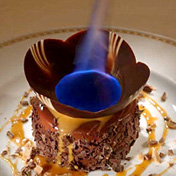
Desserts to die for

Photo supplied by the Brown Hotel

Then came the dessert. All four of us had the same dessert. It was a berry soufflé with a chocolate crème anglaise sauce.  This light dessert had a balanced combination of rich, sweet and sour flavours, all popping off with each mouthful.  HEAVEN!  AMBROSIA! Food for the Gods!

The Executive Chef came to visit our table having been told these noisy Australians were back for seconds. We gave him a loud round of applause.

He’s French Canadian, Laurent Geroli, who is a brilliant chef.  How he ended up in Louisville is beyond me, but the Brown Hotel gave a young man the Executive Chef’s hat. He fills it more than adequately. The sommelier, whose name I didn’t get, runs the restaurant, and is one of those really talented women who are awe inspiring in people oriented jobs.  She is wonderful, has a great sense of humour, remembers your name after the first meeting, and really knows her wines. If I owned a restaurant in Sydney I would kidnap both of them.

It is worth flying to Louisville to stay at the Brown and eat at the English Grill. While you are there you can visit the horse museum at Churchill Downs (and learn the story of SECRETARIAT, America’s PHAR LAP) and the Muhammad Ali museum.  Both are worth visiting.

The Brown Hotel also has a historic signature dish called the Hot Brown. I warn you this is a dish not to be eaten in 90f heat which I made the mistake of doing. It is a ripper of a dish, especially as comfort food on a cold winter’s day. I include the Brown Hotel’s recipe for your enjoyment. You won’t need to eat for 24 hours afterwards.

The Hot Brown

Photo supplied by the Brown Hotel

The Legendary Hot Brown Recipe

Ingredients (Makes Two Hot Browns):

  • 2 oz. Whole Butter
  • 2 oz. All Purpose Flour
  • 1 Qt. Heavy Cream
  • 1/2 Cup Pecorino Romano Cheese, Plus 1 Tablespoon for Garnish
  • Salt & Pepper to Taste
  • 14 oz. Sliced Roasted Turkey Breast
  • 2 Slices of Texas Toast (Crust Trimmed)
  • 4 slices of Crispy Bacon
  • 2 Roma Tomatoes, Sliced in Half
  • Paprika, Parsley

In a two-quart saucepan, melt butter and slowly whisk in flour until combined and forms a thick paste (roux). Continue to cook roux for two minutes over medium-low heat, stirring frequently. Whisk whipping cream into the roux and cook over medium heat until the cream begins to simmer, about 2-3 minutes. Remove sauce from heat and slowly whisk in Pecorino Romano cheese until the Mornay sauce is smooth. Add salt and pepper to taste.

For each Hot Brown, place one slice of toast in an oven safe dish and cover with 7 ounces of turkey. Take the two halves of Roma tomato and set them alongside the base of turkey and toast. Next, pour one half of the Mornay sauce to completely cover the dish. Sprinkle with additional Pecorino Romano cheese. Place entire dish under a broiler until cheese begins to brown and bubble. Remove from broiler, cross two pieces of crispy bacon on top, sprinkle with paprika and parsley, and serve immediately.

For “broiler” think “grill”.  (J).

http://www.brownhotel.com/the-english-grill.htm

NEW YORK STORIES – Part 2

New York’s Rag Trade – a trade no longer.

photo by author, 19/06/2011

She moves with a dancer’s ease and grace. It becomes a compelling performance as you see her go in and out of the clothes’ racks lining the showroom she now shares with other designers. Pulling out one outfit after another from her autumn collection, her clothes are a reflection of the woman herself – an overwhelming impression of understated elegance. Hints of Givenchy, Chanel and Yves St Laurent at their prime combined with a dash of something new are evident in these clothes. Attention is given to the smallest detail; the cut, the choice of fabric, colour, as well as the embellishments that are buttons, alternative fabrics, and appliques.  Additions, that don’t take over but rather enhance the creation.

Her name is Ildi Marshall and this woman is an artist. She has that kind of cream pot skin for which sun kissed Australian women would sacrifice their eye-teeth, a dancer’s trim figure and wears a simple black frock to perfection. I  listen to her story, a personal story  covering four decades working in the fashion business, and  therefore reflecting the ups and downs of the rag trade in New York.  Every now and then I wonder how old she is, but deem it too rude to ask.

At the height of her business, she had 3,000 square feet in which she employed over 30 people. These were the days when the New York designers did more than just design clothes. They employed people who cut, sewed and finished their garments as well as marketed and sold them directly to the department and smaller stores that attended the biannual shows.

Those days are long gone.

We are on a tour of the garment district and I could sit in the gutter and weep. From 6th to 9th Avenues, from 30th to 40th Streets we walk. The streets are now deserted. Shops that once sold fabrics and accessories to the rag trade are empty with for lease signs hanging in the window. Accompanying legal notices warn that nothing is to be taken from the store. So they sit there with stock still on display and a pile of correspondence growing each day. There are the occasional stores that are still open for business. They are a reminder of what once was.  It is like walking through a living history museum.

In streets that used to be so full of people they were impossible to drive down, it is easy to imagine how it must have been.  Streets clogged with clothes racks bulging with garments in their various stages of manufacture, covered in clear plastic to protect them from the elements, the hustle and bustle, the noise and the sheer electric excitement that was the daily experience for all workers in the garment district at a time when it was at its peak. It was the busiest part of New York.

Immigrants, mainly Jewish and Italian, then Hispanic and Asian, could get a job in the rag trade. You don’t need to speak English to be able to use a sewing machine in a sweatshop or launder the finished product.

Photo from the US Congressional Library

The history of manufacturing in the United States is reflected in the garment industry. It was here the first big struggles were waged in the policy areas of occupational health and safety, social security, minimum wages and the like.

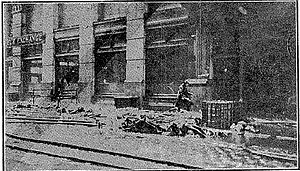
In 1911 there was a fire at New York’s Triangle Waist Shirt Factory and over 140 people, mainly teenage migrant girls, were killed. This incident is still remembered every year with a ceremony that includes the victims’ names being read out.

Close to the end of their shift one Saturday afternoon in a factory that had wooden floors covered with scraps of fabric discards, and mixed with oil from sewing machines, a spark caused this floor ‘fuel’ to ignite. When the girls tried to escape they found the fire escape doors were locked. In 1911 fire engines didn’t have ladders that extended to the 8th floor and above. The girls who worked on the 8th, 9th and 10th floors jumped to their death in scenes reminiscent of 9/11. There was a huge public outcry.

Photos from the US Congressional Library

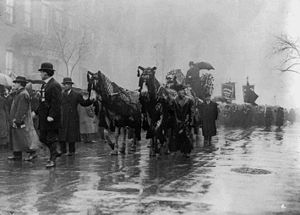
100,000 people marched in the funeral procession and 400,000 people lined the streets.  The first occupational health and safety regulations were introduced as a result.

In 2000 a fire broke out in the Chowdhury Knitwear factory in Bangladesh. Forty-six girls were killed. They were aged between 12 and 14 years. When the investigators went through the charred remains of the factory they discovered that the fire escape doors were locked. This factory’s output was for American designers and subsequent sale in the American market.

The 20th century that chronicles the garment industry’s rise and fall starts and ends with sweat shops, teenage girls and fire.

The story of the 90 years in between is a remarkable one. New York was not built on banks, advertising agencies, the investment and securities’ market, but on the blood, sweat and tears of the garment industry. For over a century the garment industry was the single largest employer in New York. This industry’s importance to New York cannot be overstated.

In 1965, 95% of all clothes sold in the USA were made in the USA,  3/4 of which were made in New York. In 1975  the percentage of all clothes sold in USA being manufactured in USA fell to 87%, 1985 – 70%, 1995 – 50%, and in 2009,  a miserly 5% .

The rag trade is a microcosm of the policy initiatives that have facilitated the demise of the American industrial base. The result is an economy that is now dysfunctional and a middle class that is fast disappearing. Aspirational politics has no answers. For the first time in American history the middle class face the prospect that their children will not do better but fare worse than the generations that have gone before.

Ildi Marshall reflects the garment industry’s last four decade history.  She now works as a one-man band. She designs and cuts these beautiful garments, sending them out to one of the few sewing and finishing manufacturers left operating in the area designated by the City Council as the garment district. This industry has gone from a cottage industry to a full manufacturing industry and back again.  Ildi  complains about the value of the US dollar doing terrible things to the purchase price of the fabric she gets from Italy and France, the loss of competition in choosing a manufacturer for sewing and finishing, the lack of choice and quality of fabric and accessories available locally and the disappearance of the skilled trades essential to her business.  But she continues on producing beautiful clothes. She not only has the genius but, more importantly, the passion that comes with talent.

Between you, me and the gate post,  Ildi Marshall is 74.

To contact Ildi Marshall: ildimarshall@gmail.com

TERESA BRENNAN (1952 – 2003)

Nobody could smoke a cigarette quite like Teresa Brennan. Only Bette Davis in ’Now Voyager’ came close. With mesmerizing elegance Teresa used a cigarette to indicate how she was feeling about what was being said or done, or as a weapon when arguing a point in any debate. It was the first thing I noticed about her, her hands. They were very beautiful. I can still see the patterns the smoke created as she gesticulated, emphasizing whatever needed to be emphasized.

I first met Teresa Brennan during a Sydney University Orientation Week function put on by the Students’ Representative Council for freshman undergraduates. It was 1970 at the beginning of the academic year. Teresa gave the welcoming speech and introduced Barry Robinson, President of the SRC, who was later to be best man at my wedding. Bet, my mother, Ruth, my sister, and I settled down for what we expected to be a turgid night of boring speeches. We couldn’t have been more wrong. It was a night that would determine the direction that my life would later take and, ultimately, the person with whom I would share that journey.

Teresa was a voluptuous woman with cream pot skin and only the occasional sun kissed freckle, a mouth that was always threatening to break into laughter, and eyes that twinkled with amused devilment. She was never happier than standing in the middle of chaos, delight dancing across her face, calmly and elegantly smoking a cigarette, as all around her went to the shithouse. She was as Irish as Paddy’s pigs, potatoes, shamrocks, Guiness and leprechauns.

The first two speeches were as expected – dire. I whispered my apologies to Bet and Ruth for dragging them off to this. The next speech was given by an overly large under-grad whose name I recall was something Clarke who looked like he could have done with one or two turns in the Hoover washing machine set on heavy duty.

His was an outrageous speech, full of expletives undeleted and deliberately confronting. No sensitive subject, from drugs to group sex to final bloody revolution, was left untouched. Parents were on their feet shouting at the stage; others were noisily exiting while Bet, Ruth and I sat there and cacked. We were the only ones in the entire Union Theatre who applauded. It was one of the more entertaining meetings we had ever attended. All the time Teresa stood quietly smoking at the side of the stage as pleased as punch, while the audience’s veneer of middle class politeness and pretensions was stripped away, leaving outraged mayhem. Our response did not go unnoticed.

At the end of the meeting we went to leave and she smiled. So we met. She met a family of Evatt women, and I met my mentor during my university years and my friend. She was fun; had a frighteningly brilliant intellect; was difficult, demanding, loyal, stimulating, and I loved her.

Three weeks after I had first met her I was attending one of her parties.  Teresa threw the best parties. You would always meet the most interesting people and engage in stimulating banter, usually political mixed with heavy doses of slanderous gossip. At this party I remember meeting for the first time Jim Spigelman, later to be Chief Justice of NSW, was then Editor of Honi Soit, Percy Allen, later Head of NSW Treasury, was then standing, ultimately successfully, as President of the SRC, and the man I would eventually marry, His Nibs. There was an entry to student politics although that never interested me as much as Labor politics. Even at the beginning of the 70s student politics was too polite. Labor politics was more combative and I like blood sports.

Memories are like archaeological artifacts. Some shards instantly bring back a whole story with cast and context; others require digging into the memory to piece together fragments of your remember when.

My memories of Teresa are all from the former category; clear, crisp reenactments, complete with vision and surround sound. The reason is Teresa herself. She was such a dynamo and stories about her, and we have a gigillion, where His Nibs and I were either unexpected participants or spectators, are the full 3 act dramas, tragedies or absurdist comedies.

When 4 Corners rang us requesting an interview for the piece on Marcus Einfeld, we refused. His Nibs had introduced Teresa to Marcus and that much we confirmed. I did make the comment to the show’s researcher that the real story wasn’t Marcus it was Teresa, and the mysterious manner in which she had been killed.

At last! A book has been written in which the suspicious circumstances surrounding her death are raised – ‘A Tragedy in Two Acts: Marcus Einfeld and Teresa Brennan” by Fiona Harai, published by Victory Books and is released today. An edited extract appeared in the SMH’s Good Weekend, 27 August 2011, under the banner of ‘It happened one night’.

The debacle that resulted in Marcus Einfeld’s demise fits nicely into the absurdist theatre category. Speculation about how Teresa would have reacted to the kerfuffle is still revisited.  Silly, I know! My view? I like to think that she would take a long elegant drag on her fag, eyeball you with eyes twinkling then throw her head back and cack with laughter.